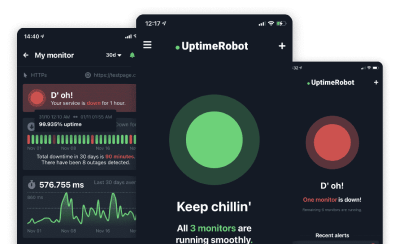
What is Uptime?
In simple words, uptime is the amount of time that a service or system is available and operational. In theory, a service with 100% uptime would be available 24/7, without a single pause.
TIP: Read our detailed post about how to calculate uptime.
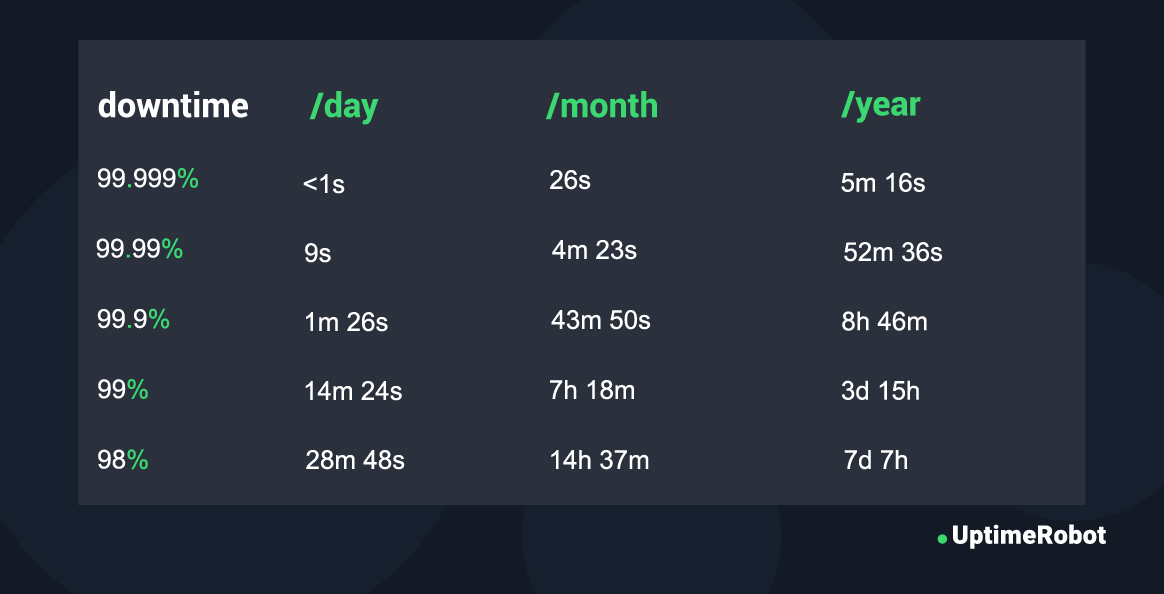
The difference between various uptime percentages may seem insignificant on the surface but look deeper and you’ll find that even a tiny fraction of a percentage makes a huge difference. Consider this: an uptime of 95% suggests that your website could be unavailable for a whopping 18 days in a year. Bump that up to 99%, and you’re looking at a reduced, yet still significant, potential downtime of nearly four days per year.
What “999 Uptime” Actually Buys You in Real Downtime
“999 uptime” sounds abstract until you translate it into time. It means 99.9 percent availability over a defined period. The definition of that period is where expectations often break.
Uptime is always measured against a window, usually a month or a year. For a 30-day month, 99.9 percent uptime allows about 43 minutes of downtime. That is the entire budget. One incident can consume it. Several smaller ones almost always do.
This is why 999 uptime feels reliable most of the time, but still produces noticeable outages. Forty minutes spread across multiple incidents feels worse than one clean failure, even if the percentage looks the same on paper.
The jump between nines is also non-linear. Each extra nine cuts allowable downtime by a factor of ten:
-
99 percent allows over seven hours per month
-
99.9 percent allows about 43 minutes
-
99.99 percent allows about four minutes
That difference matters operationally. Reaching 99.9 usually requires basic redundancy and alerting. Moving beyond it often means regional failover, tighter deploy controls, and faster detection. The cost curve rises fast.
Another common misunderstanding is what counts as downtime. Planned maintenance, partial outages, slow responses, and third-party failures are often excluded or debated after incidents. If the definition is fuzzy, the uptime number loses meaning. Teams should agree on what is included before measuring anything.
Percentages also hide user impact. A backend API can meet a 99.9 target while users experience repeated short failures during peak hours. This is why uptime should not stand alone. Pair it with metrics like longest outage, incident count, and response time.
999 uptime is a reasonable target for many services. It balances effort and reliability without demanding extreme complexity. It is not “near perfect,” and it does not mean users will never notice issues.
The useful question is not “do we hit 99.9,” but “what failures fit inside that budget, and are we comfortable with them?” Once you answer that honestly, the number starts working for you instead of against you.
Unpacking 99.99% Uptime
So how much uptime is 99.9%? Are you now getting basically no downtime at all when you reach this level? Sorry, but no — the number might sound near perfect, but still equates to almost 9 hours of potential downtime in a year. That’s an entire workday that your website or digital service could be out of action!
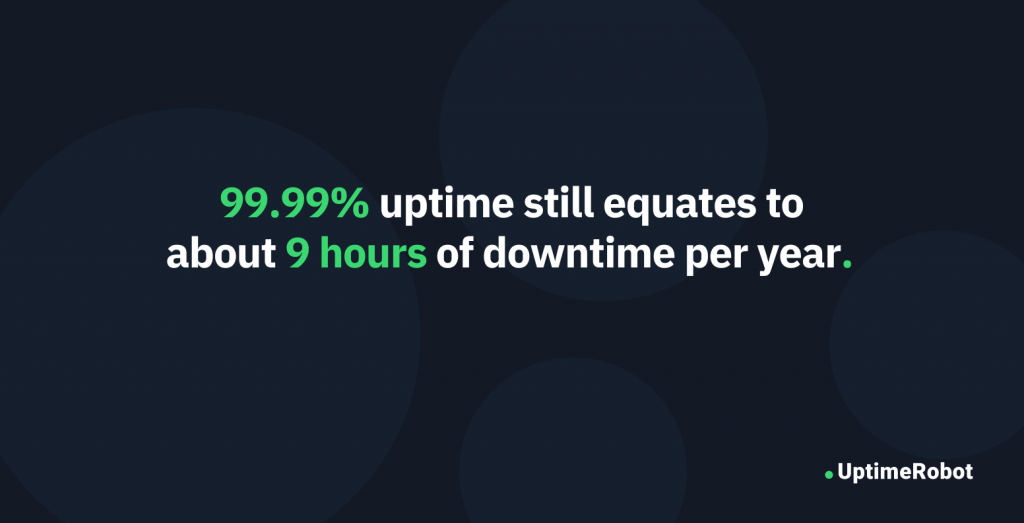
If we break down 99.9% uptime even further, it comes down to about 43 minutes of downtime per month or almost two minutes per day. That might not seem like much, but a survey conducted by Digital.com showed that “53% of online shoppers expect e-commerce pages to load in 3 seconds or less” and will leave if the website takes longer than six seconds to load.
If you take those numbers into account, two minutes it’s actually an eternity. Just how many potential clients or sales will you lose in those minutes?
For businesses that depend heavily on their online operations, those few hours of downtime could lead to substantial revenue loss and customer dissatisfaction.
What about 99.999% uptime?
If you’re up for reaching for an even loftier goal, there’s always 99.999% uptime, often referred to as the “five nines” or “high availability (HA).” Simply put, “five nines” is a term for the availability of a service or component that is operational 99.999% of the time.
TechTarget further defines it as “the ability of a system to operate continuously without failing for a designated period of time. HA works to ensure a system meets an agreed-upon operational performance level.”
A 99.999% uptime is considered the gold standard in many industries, particularly those where service availability is absolutely crucial, such as telecommunications, healthcare, and financial services. At 99.999% uptime, the allowance for potential downtime shrinks dramatically.
Remember how you’re losing 8.76 hours of potential uptime per year with 99.9% uptime? Well, with 99.999% uptime, the time your website is down adds up to just a little over 5 minutes per year. Now, that’s impressive!
However, achieving five nines of uptime is no small feat. It requires a substantial investment in infrastructure, a team of skilled professionals always available, and strong system fallback procedures.
The good news is that while 99.999% uptime is a great goal, it may be overkill for some businesses — the cost of achieving 99.999% uptime would be so high that it would likely outweigh the potential losses for most businesses, according to Nobl9.
The goal of 99.999% uptime is, in fact, so big that not even the internet giants are succeeding at it on a regular basis.
As reported via IOD, Urs Hölzle, senior vice president for operations at Google has said that “We don’t believe Five 9s is attainable in a commercial service, if measured correctly. The company’s goal for its major services is Four 9s … Last year, Gmail’s availability was 99.984 percent (This is the percentage of requested actions, such as sending off a message, that were successful).“
Achieving 99.99% uptime, on the other hand, might be more attainable for medium-sized businesses. The “four nines” were once a very expensive endeavor, requiring multiple data centers or cloud service providers, an expensive database layer with active/passive configurations, and a full-time team, according to Jared Wary, CTO and Co-Founder of Palmetto. Today, however, a low-cost cloud computing setup could achieve 99.99% availability for around $1,200 a month through Cloud Flare, Google Cloud (Cloud Run), and an affordable database layer like MongoDB Atlas Global Cluster.
At least, that’s the case for smaller sites and businesses. Huge companies with very heavy traffic, like Amazon, will find the task a bit trickier.
For 99.999%, however, you’re still looking at huge costs in the tens and potentially hundreds of thousands of Dollars — costs that might actually not make sense for your business. According to business-oriented software CTO Itzy Sabo, “Guaranteeing this level of reliability requires specialized architecture, redundant infrastructure, and streamlined operational and organizational procedures. If you don’t need it, it’s not cost-effective. Most businesses do not need 99.999% (“five-nines”) uptime, or even 99.99% (“four-nines”).”
Uptime Guarantees in Service Level Agreements (SLAs)
Service providers often tout their uptime percentages in Service Level Agreements (SLAs). These are contractual commitments that promise a certain level of service availability. If the provider fails to meet their uptime guarantee, SLAs typically stipulate some form of compensation, usually as credits towards future service.
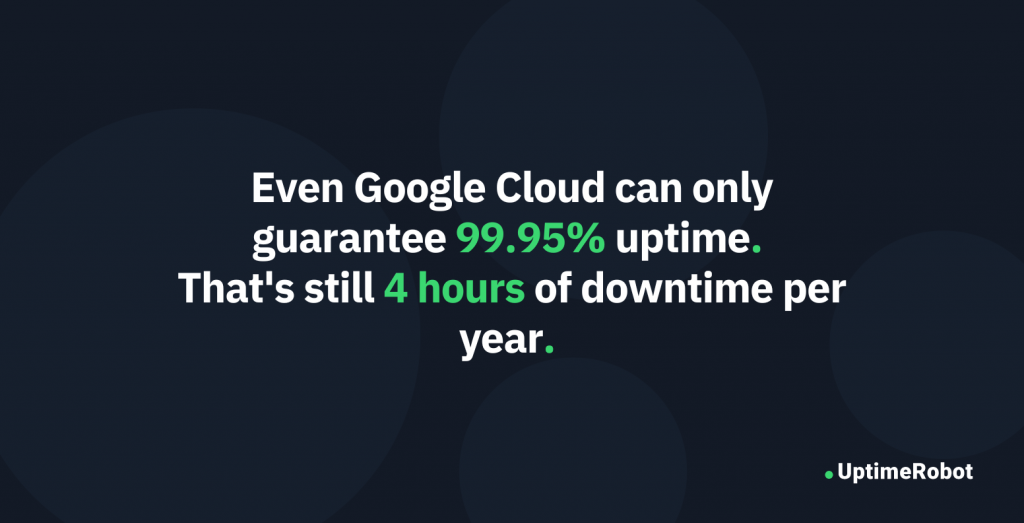
The thing to keep in mind, however, is that numbers that sound impressive, usually aren’t. For example, in its SLA, Google Cloud Platform to Customer agrees to provide a “Monthly Uptime Percentage to Customer of at least 99.95% (the “Service Level Objective” or “SLO”).” Based on the calculations above, that’s still almost 22 minutes of downtime a month (and over 4 hours per year).
Amazon does a little better, guaranteeing that services included in the agreement will be available for 99.99% in any given region in any monthly billing cycle. This equates to 4.38 minutes of permitted downtime per month or about 53 minutes per year.
Wondering how to check uptime to see what you’re really getting from your server? UptimeRobot is a fantastic tool designed to help you monitor your website’s availability around the clock. If your site does go down, UptimeRobot will notify you right away so you can jump into action to resolve the issue and minimize the impact of any downtime.
The Impact of Downtime
Downtime can wield a devastating blow to businesses. Aside from the immediate loss of sales or productivity, there’s also the potential damage to a company’s reputation and customer trust to consider. In a world where consumers expect constant availability, service interruptions can lead to customer churn and negative reviews.
A glaring example of this was the Amazon outage in 2013. The interruption lasted for a mere 30 minutes, but the estimated loss in sales was nearly $2 million. That’s a stark reminder of the high stakes of maintaining uptime.
A 2016 study by the Ponemon Institute found that the average total cost of a data center outage in the US was $740,357. This figure accounts for not just direct loss of revenue, but also the time and money spent on dealing with reduced productivity from end-users, expenses to replace faulty equipment, detection and recovery, and the potential harm to the company’s reputation.
Strategies for Achieving Higher Uptime
So how can businesses strive for that elusive 99.99% availability? For starters, by investing in proper backup systems that can take over when there’s a service interruption. For 99.99% SLA, this could mean having extra servers, databases, network paths, and even power supplies available.
Regular maintenance and system updates also play a key role in maintaining high uptime. Outdated software or hardware can be prone to failures, and neglecting updates can leave systems vulnerable to cyberattacks, which can lead to downtime. Routine checks and maintenance help identify potential issues before they cause service interruptions.
Investing in quality infrastructure and services is another essential step towards achieving higher uptime. Outdated data center servers are more likely to experience a service interruption, increasing the risk of downtime.
Understanding what 99.9% uptime really means can be tricky business. While it might seem close to perfect, that tiny 0.1% can equate to substantial potential downtime in the grand scheme of things. In the digital world, where every minute of service disruption can translate to thousands of dollars lost, striving for higher uptime can make a world of difference.
So the next time you encounter an uptime guarantee, just remember “the more nines, the better.” The number is a measure of the real-world implications of potential downtime and a reminder that in our always-on digital world, every second of uptime counts.
After all, in a world that never sleeps, why should our digital services?
FAQ’s
What does 99.9% uptime actually mean?
99.9% uptime means a service is allowed about 0.1% downtime over a given period. Over a 30-day month, that equals roughly 43 minutes of downtime. Small percentage changes translate into real, noticeable outages.
How much downtime is acceptable with 99.9% uptime?
With 99.9% uptime, downtime adds up quickly across weeks and months. While it may sound reliable, users can still experience multiple short outages. This level is often acceptable for internal tools but risky for customer-facing systems.
Is 99.9% uptime considered good?
It depends on your use case. For low-impact services, 99.9% may be sufficient. For revenue-critical or user-facing applications, many teams aim higher because even brief outages can cause user churn or financial loss.
What’s the difference between 99.9% and 99.99% uptime?
The difference is downtime tolerance. 99.9% allows about 43 minutes per month, while 99.99% allows roughly 4 minutes. That extra “nine” significantly raises reliability expectations and operational effort.
Does planned maintenance count toward 99.9% uptime?
That depends on how uptime is defined in your SLA or internal metrics. Some teams exclude planned maintenance, while users still experience it as downtime. The key is to define and communicate this clearly.