An incident is not over when the service is back up. If the team skips the review, the same gaps in alerting, communication, ownership, or response tend to show up again in the next outage.
A good post-mortem meeting turns a messy incident into something useful: a clear timeline, a root cause, and a short list of fixes worth making.
This guide walks through what a post-mortem meeting is, how to prepare for one, and how to run it without turning the room defensive. It covers the structure, the questions that move the discussion forward, and the follow-up actions that matter after the meeting ends.
What is a post-mortem meeting?
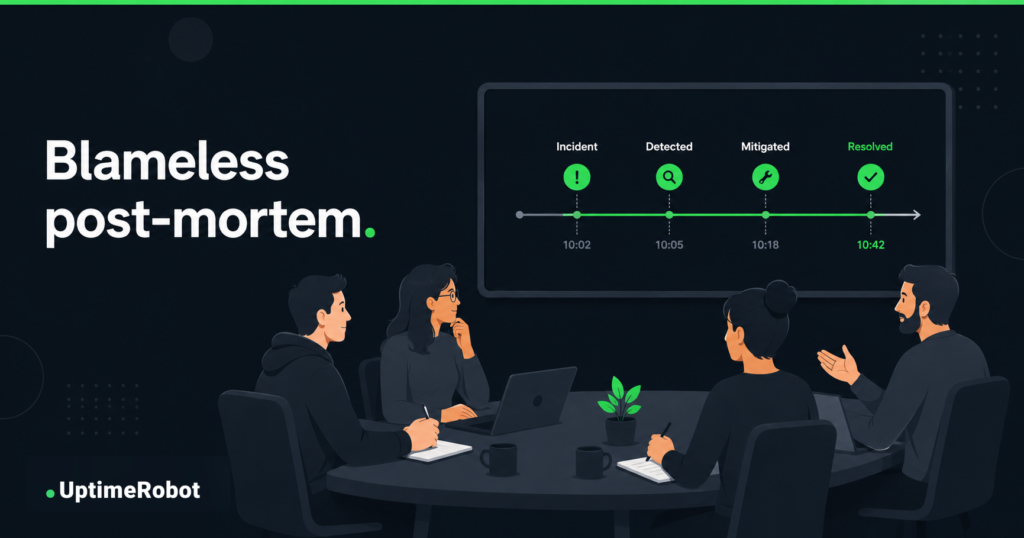
A post-mortem meeting, also known as a retrospective or debrief, is a structured discussion held at the conclusion of a project to evaluate its outcomes and identify lessons learned.
It provides a forum for project teams to reflect on what went well, what could have been improved, and how to apply these insights to future projects.
In essence, a post-mortem meeting serves as a final step in the project lifecycle, allowing teams to:
- Reflect: Review the project’s objectives, processes, and outcomes in a systematic manner.
- Learn: Identify successes, failures, and areas for improvement to inform future decision-making.
- Iterate: Incorporate changes and optimizations based on the insights gained from the post-mortem analysis.
Fostering open internal communication and a culture of continuous learning through post-mortem meetings empowers teams to refine their practices, mitigate risks, and improve overall project performance.
How to prepare for a post-mortem meeting?
Preparation is key to having a productive and insightful post-mortem meeting. Here’s a loose step-by-step guide on how to prepare effectively. Your mileage may vary, so choose these steps as they suit your needs.
- Gather feedback: Encourage team members to provide feedback on what worked well and what could be improved next time. This can be done through pre-meeting discussions, surveys, or questionnaires.
- Get hard statistics: If applicable, get all of the numerical data results from the project together and be prepared to present all of it clearly and concisely.
- Establish baselines: Define the project’s baseline metrics for things such as cost, time spent, and overall completion. If you set up SMART goals at the beginning, these can be used as your benchmarks
- Choose a moderator: Select a moderator with leadership skills and a thorough understanding of the project. The moderator will facilitate the meeting, keep discussions on track, and make sure all participants have the opportunity to contribute.
- Choose main points: As the project manager, identify key topics for discussion based on your own observations and feedback from team members. These talking points will form the basis of the meeting agenda.
- Create a presentation: Put together a presentation summarizing the project’s successes, challenges, and key insights. This document will guide discussions during the post-mortem meeting and make sure all relevant points are addressed.
- Develop an agenda: Make a detailed agenda outlining the meeting’s objectives, discussion topics, and ground rules. Share the agenda with participants in advance to get everyone prepared and align them with the meeting’s goals.
By taking these preparatory steps, you’ll set the stage for a focused and constructive post-mortem meeting that drives meaningful insights and actionable outcomes.
Do you need a project post-mortem meeting?
Project post-mortem meetings are valuable for organizations of all sizes and across many industries. Consider these benefits of post-mortem meetings before you start.
Continuous improvement
Learning from successes and failures is as important in the workplace as it is in real life. Post-mortem meetings provide an opportunity to reflect on project outcomes and identify what worked and what could be changed.
Knowledge sharing
Post-mortem meetings facilitate knowledge sharing among team members. Giving a space to their experiences and thoughts, team members can gain a deeper understanding of project dynamics and best practices, as well as what their teammates do to contribute.
Accountability
Holding post-mortem meetings encourages accountability within the team. By openly discussing challenges and responsibilities, team members can take ownership of their actions and collaborate more effectively.
Stakeholder engagement
Post-mortem meetings can involve key stakeholders, such as clients or project sponsors, which provides more transparency and alignment. Using board portal software to facilitate these meetings allows for better communication and collaboration, ensuring that all stakeholders are on the same page. Involving stakeholders in the review process helps organizations strengthen relationships and manage expectations more effectively.
Overall, project post-mortem meetings drive organizational learning, strong collaboration, and continuous improvement across projects and teams.
5 steps on leading a post-mortem meeting successfully
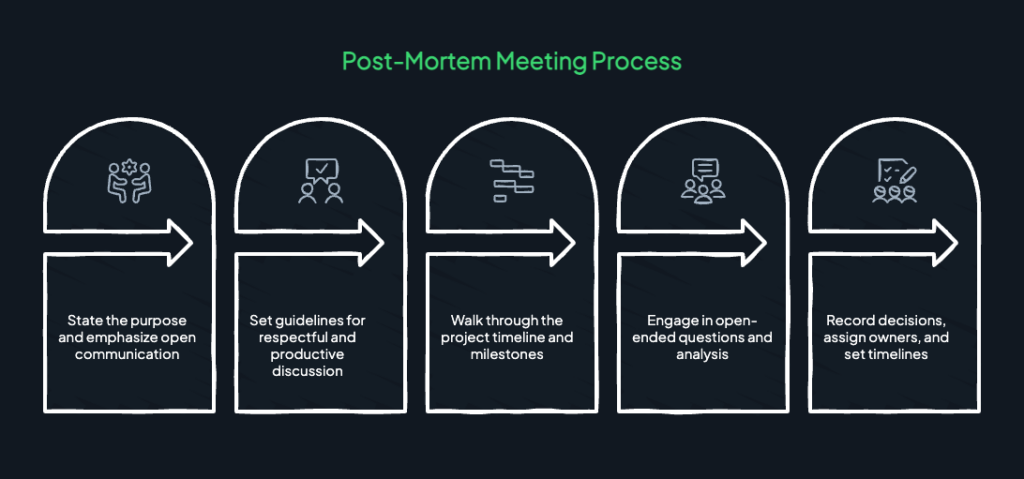
Leading a post-mortem meeting requires careful planning and effective facilitation to ensure that the meeting concludes with everyone coming away with valuable information and actionable suggestions for the future (if applicable).
1. Set the stage
Begin by clearly articulating the purpose and objectives of the post-mortem meeting to all participants. Emphasize the importance of open communication, constructive feedback, and a collaborative mindset.
2. Establish ground rules
Not every post-mortem meeting is going to be a celebration; and there may be times where the conversation gets difficult or heated. Establish ground rules for the meeting to keep the discussion productive and respectful. Encourage participants to share their perspectives openly, while maintaining a focus on problem-solving and improvement.
Some ground rules may include:
- Respect each other’s opinions and viewpoints.
- Avoid assigning blame and focus on identifying solutions.
- Ensure everyone has an opportunity to speak without interruptions.
- Stay focused on the agenda and avoid tangential discussions.
3. Review the project
Provide a complete overview of the project, including its objectives, timeline, deliverables, and key milestones. Highlight both successes and challenges encountered during the project to set the context for the discussion.
This will look different for every industry, so feel free to do some trial and error, or look up more industry-specific tips for what kind of presentation is best for you.
4. Open discussion
Encourage active participation from all team members by asking open-ended questions and probing for insights.
Use techniques such as brainstorming, root cause analysis, and SWOT analysis to explore different aspects of the project in depth.
Keep the discussion focused on identifying lessons learned and actionable recommendations for future improvement.
5. Document action items
As the meeting progresses, document key insights, action items, and decisions made. Assign responsibilities for follow-up actions and establish clear timelines for implementation.
Be sure that all participants have access to the meeting minutes and action items for reference.
Following these steps and adding your own what suit your needs can help you lead a post-mortem meeting that promotes reflection, learning, and continuous improvement within your team or organization.
Questions to ask in a post-mortem meeting
A post-mortem meeting works best when the questions move from facts to causes to next steps. If the discussion stays too broad, teams usually repeat the same points and leave without clear changes.
Start with the timeline.
What was supposed to happen, and what actually happened? When did the project start to drift from plan? Which decisions helped, and which created delays, confusion, or rework?
These questions keep the conversation grounded in events instead of opinions.
Then look at contributing factors.
Were the goals clear from the start? Did roles, deadlines, or approvals create friction? Did tools, documentation, or communication gaps slow the team down?
This is often where the most useful lessons appear, because the problem is rarely one mistake by one person.
It also helps to ask what went well.
Which part of the plan worked as expected? What helped the team recover from setbacks faster? Which habits, tools, or checkpoints should stay in place for the next project?
A good post-mortem should protect strong processes, not just fix weak ones.
Close with forward-looking questions.
What should the team start doing, stop doing, or keep doing next time? Which fixes matter most right now? Who owns each action item, and when will progress be reviewed?
If those answers are vague, the meeting may feel productive without leading to real improvement.
Keep the list short during the meeting. A few direct questions usually produce better discussion than a long checklist.
-
A post-mortem meeting is a structured review held after a project, incident, or major release to understand what happened and what should change next time. The point is not to rehash every detail, but to capture useful lessons while the context is still fresh. A good post-mortem turns experience into better process.
-
You should hold it soon after the project or incident ends, while timelines, decisions, and pain points are still clear. Waiting too long usually leads to vague feedback and missed details. A short delay is fine if the team needs time to gather facts first.
-
Invite the people who were directly involved in planning, execution, support, or decision-making. That usually includes the project owner, key contributors, and anyone who can explain blockers, dependencies, or outcomes. Keep the group focused enough to be useful, but broad enough to avoid a one-sided review.
-
A post-mortem meeting is often tied to a finished project, launch, or incident, while a retrospective is commonly used as a recurring team reflection during ongoing work. In practice, both aim to identify what worked, what did not, and what to improve. The main difference is usually timing and scope, not intent.
-
Set the tone early by focusing on systems, decisions, and process gaps instead of individual fault. Ask questions like “What made this harder than expected?” rather than “Who caused this?” A blame-free format makes people more honest, which leads to better fixes.
-
A practical agenda should cover the goal, a short timeline of what happened, what went well, what did not, root causes, and what should change next time. It also helps to document assumptions that turned out to be wrong or incomplete. Keep the structure simple so the team spends more time analyzing than presenting.
-
After the meeting, document the main findings and turn them into specific follow-up actions with owners. Then review whether those changes were actually implemented instead of letting the notes sit unused. The value of a post-mortem comes from the improvements that happen after it, not from the meeting itself.