You’ve got a script that needs to run on a schedule. It works in the terminal, so you run crontab -e to add the job, and that’s exactly where a lot of cron problems begin.
Editing a crontab isn’t hard, but it’s picky. One syntax slip, a missing path, or an editor mistake can stop a job cold, and cron won’t always tell you why. This guide shows you how to edit crontab safely, understand each change, and fix the “it worked before I edited it” failures.
Key takeaways
- Use
crontab -eto safely open your user’s crontab - Know which editor you’re using before making changes
- Validate cron syntax to avoid silent failures
- Always back up existing crontab entries before editing
- Check environment variables if a job stops running
- Use absolute paths and log output
What does “edit crontab” mean?
Editing a crontab means changing the list of scheduled cron jobs for a user or the system. These jobs tell cron what command to run and when to run it.
Most of the time, you are editing a user crontab. Each user has their own schedule, separate from the system-wide cron configuration.
The important distinction is how you edit it:
crontab -e: Safely edits the current user’s crontab using the cron tool.- Editing cron files directly: Modifying files like
/etc/crontabor/var/spool/cronby hand.
You should almost always use crontab -e.
When you run crontab -e, cron:
- Opens the correct file for that user.
- Handles permissions automatically.
- Validates the file before installing it.
Directly editing cron files skips these checks and can cause cron to ignore the file entirely if something goes wrong.
There’s also a difference between editing and replacing a crontab:
crontab -eedits the existing schedule.crontab file.txtreplaces the entire crontab with a new file.
That replacement approach is useful for automation, but risky for manual changes.
In short, “edit crontab” usually means opening your user’s cron schedule with crontab -e and modifying it in a controlled way, not touching cron files directly.
Which editor is used when you edit crontab?
When you run crontab -e, cron opens your crontab in a text editor. Which editor appears depends on your environment, not on cron itself.
Cron chooses the editor in this order:
- VISUAL environment variable
- EDITOR environment variable
- A system default if neither is set
If both VISUAL and EDITOR are unset, most systems fall back to vi. On some Linux distributions, especially Ubuntu, the default may be nano.
You can check what’s currently set by running:
echo $VISUALecho $EDITORIf both commands return nothing, cron is using the default editor.
Setting your preferred editor
You can choose a different editor by setting an environment variable before editing:
export EDITOR=nano
crontab -e
Or:
export VISUAL=vim
crontab -e
This change applies only to the current shell session.
To make it permanent, add the variable to your shell configuration file:
- Bash:
~/.bashrc - Zsh:
~/.zshrc
Example:
export EDITOR=nanoAfter reloading your shell, crontab -e will always open in that editor.
Debian and Ubuntu: select-editor
On Debian-based systems, you can run:
select-editorThis lets you choose an editor from a list and updates your environment automatically. It’s often the easiest option if you want to avoid vi.
Minimal systems and containers
On minimal servers or containers, no editor may be installed at all. In that case, crontab -e can fail with an error about a missing editor.
The fix is simple: install an editor and set EDITOR or VISUAL explicitly.
Knowing which editor cron uses matters because saving and exiting incorrectly can discard changes or install a broken crontab. Before editing jobs, it’s worth setting an editor you’re comfortable with.
Understanding crontab syntax before you edit
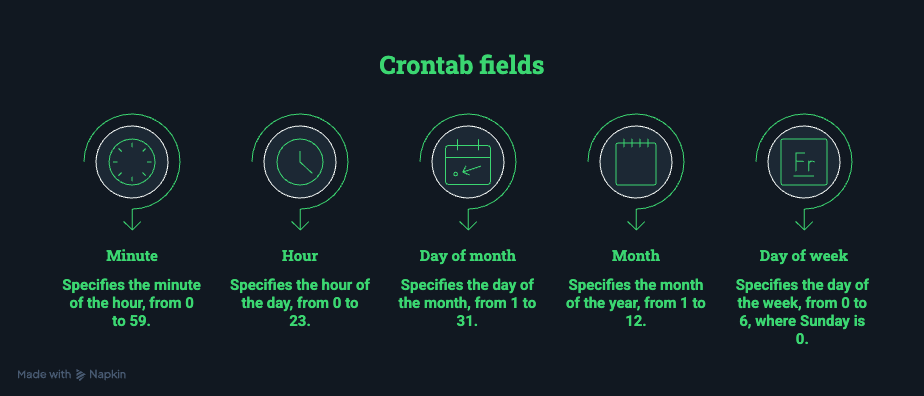
Before editing a crontab, it helps to understand how cron reads schedules. Cron syntax is simple, but it’s strict. A single mistake can stop a job from running with no obvious error.
Each cron job is defined on one line and follows this format:
* * * * * commandThe five fields control when the command runs.
The five time fields
From left to right, the fields mean:
- Minute: 0-59
- Hour: 0-23
- Day of month: 1-31
- Month: 1-12
- Day of week: 0-7 (Sunday is 0 or 7)
Example:
0 3 * * * /usr/local/bin/backup.shThis runs the script every day at 3:00 AM.
Each field must be present. If cron sees too many or too few fields, it rejects the entry.
Common patterns and operators
Cron supports a few operators that make schedules more flexible:
- * runs for every value in that field
- , separates multiple values (1,15,30)
- – defines a range (1-5)
- / sets a step value (*/10)
Examples:
*/5 * * * * commandRuns every five minutes.
0 9-17 * * 1-5 commandRuns hourly during work hours on weekdays.
Cron also supports shortcuts for common schedules:
@hourly@daily@weekly@monthly@rebootThese expand to standard cron expressions and decrease the chance of mistakes.
Syntax mistakes that break crontab
Some of the most common errors happen right here:
- Using invalid numbers like hour 25 or minute 61
- Forgetting one of the five time fields
- Mixing up day-of-week and day-of-month logic
- Copying expressions without understanding how fields interact
For example:
0 12 1 * 5 commandThis runs only when the first day of the month falls on a Friday, not on the first of the month or every Friday. If you want both, you need two entries.
Why errors appear on save
When you exit the editor, cron checks the file. If it detects a syntax problem, you may see messages like:
- bad minute
- syntax error
- errors in crontab file, can’t install
If the file fails validation, cron keeps the previous version and ignores your changes.
Before saving, it’s worth validating complex schedules with a cron expression checker. It’s much faster than debugging a job that never runs.
Tip: If you’re unsure whether your schedule is correct, use a cron expression generator to preview and validate it before saving.
Common errors when editing crontab (and how to fix them)
Most cron problems don’t come from complex schedules, they come from small mistakes that cron handles quietly. If a job doesn’t run after you edit crontab, one of these issues is usually the cause.
Syntax errors
Cron is strict about format. If a line has too many fields, too few fields, or invalid values, cron rejects it.
Examples:
0 25 * * * /path/to/script.shHour 25 is invalid.
* * * * /path/to/script.shMissing one time field.
Fix: Make sure every entry has five time fields followed by a command and validate expressions before saving.
Missing newline at the end of the file
Cron expects the crontab file to end with a newline. If it doesn’t, cron may reject the file even if the syntax looks correct.
Fix: Press Enter after the last line so the file ends with a blank newline before saving.
Editing the wrong crontab
It’s easy to accidentally edit the wrong user’s crontab.
Common mistakes include:
- Running
sudo crontab -ewhen you meant to edit your own - Editing
/etc/crontabinstead of a user crontab - Forgetting which environment a job belongs to
Fix: Use crontab -e for your user. Use crontab -u username -e only when you intend to edit another user’s jobs. Confirm changes with:
crontab -lCron rejecting the file on save
If cron detects an error when you exit the editor, you may see a warning and the changes won’t be installed. In some cases, the error message is brief or unclear.
Fix: Read the error message carefully. If cron refuses the file, it keeps the previous version. Fix the issue and save again.
Invalid users or permissions
Cron runs jobs as the user who owns the crontab. If a job references files or scripts the user can’t access, the job fails.
Fix: Check file ownership and permissions and make sure scripts are executable and readable by the correct user.
chmod +x /path/to/script.shSilent failures after a “successful” edit
Sometimes crontab installs without errors, but jobs still don’t run.
This usually means:
- A PATH issue
- A relative path was used
- An environment variable is missing
Fix: Use absolute paths and log output explicitly so failures are visible.
Cron doesn’t warn you when things go wrong. It just stops running the job. Catching these common mistakes early saves time and avoids silent failures.
Why cron jobs stop working after editing crontab
When a cron job works in your terminal but stops running after you edit crontab, the problem usually isn’t the schedule. It’s the environment cron runs in.
Cron executes jobs in a very limited, non-interactive context. That difference is the root cause of most post-edit failures.
Cron uses a minimal environment
Cron does not load your shell profile files. That means variables you rely on in your terminal may not exist when the job runs.
Common examples:
PATHis much shorter than expectedPYTHONPATH, NODE_ENV, or custom exports are missing- Shell aliases are ignored
A command like this may work manually but fail in cron:
my_script.shFix: Use absolute paths and define required variables explicitly.
/usr/local/bin/my_script.shOr set variables at the top of the crontab.
PATH issues are the most common cause
Cron’s default PATH often looks like this:
/usr/bin:/binIf your command lives in /usr/local/bin, cron won’t find it.
Fix: Either call the binary directly:
/usr/local/bin/python3 /home/user/script.pyOr define PATH explicitly:
PATH=/usr/local/bin:/usr/bin:/binRelative paths do not work reliably
Cron does not run jobs from your home directory unless you tell it to. Any command that assumes a working directory can fail.
Bad example:
./backup.shFix: Always use full paths for scripts, files, and output locations.
Shell differences can break scripts
Cron uses /bin/sh by default, not Bash. If your script relies on Bash-only features, it may fail silently.
Fix: Specify the shell explicitly:
SHELL=/bin/bashOr add a proper shebang at the top of your script:
#!/bin/bashOutput is discarded unless you capture it
If a cron job fails and output is not redirected, you won’t see any errors.
Fix: Redirect both stdout and stderr to a log file:
/path/to/script.sh >> /var/log/cron.log 2>&1This gives you something concrete to debug.
When cron jobs stop working after an edit, it’s almost always because the job depends on something cron doesn’t provide by default. Absolute paths, explicit variables, and logging remove most of that uncertainty.
Setting environment variables when editing crontab
Cron jobs do not inherit your interactive shell environment. If a script depends on variables that exist in your terminal, you need to define them explicitly when you edit crontab.
This is one of the most reliable ways to prevent jobs from breaking after changes.
Where environment variables belong in a crontab
Environment variables must be defined at the top of the crontab, before any scheduled jobs.
Example:
SHELL=/bin/bash
PATH=/usr/local/bin:/usr/bin:/bin
HOME=/home/username
MAILTO=alerts@example.com
After that, your cron jobs can follow normally:
0 3 * * * /home/username/scripts/backup.shCron applies these variables to every job in the file.
Variables you should usually define
These are the most commonly needed variables when editing crontab:
PATH: Cron’s default path is very limitedSHELL: Defaults to /bin/sh, which may not support your scriptHOME: Some tools expect it to be setMAILTO: Controls where cron sends job output
If you skip these, jobs that worked before can fail without warning.
Defining custom variables
You can also define variables your scripts rely on:
ENV=production
LOG_DIR=/var/log/myapp
Then reference them inside your scripts:
echo "Running in $ENV mode" >> $LOG_DIR/app.logThis keeps configuration out of the command itself and makes jobs easier to maintain.
Avoid storing secrets like API keys directly in crontab files. Anyone with access to the crontab can read them. Use a config file with restricted permissions or a secrets manager instead.
When to move logic into a script
If your crontab line starts getting long or complex, it’s a sign the logic belongs in a script.
Instead of this:
0 * * * * cd /app && source venv/bin/activate && python run.py >> log.txt 2>&1Do this:
0 * * * * /app/run_job.shAnd put the setup logic inside run_job.sh. This makes debugging easier and reduces the chance of syntax errors in crontab itself.
Setting environment variables explicitly removes a lot of guesswork from cron behavior. When variables are predictable, failures become much easier to diagnose.
How to edit another user’s crontab (safely)
Editing another user’s crontab is common on shared servers, but it’s also where mistakes can affect the wrong jobs or the wrong environment. The key is to use the correct command and avoid editing cron files directly.
Use the crontab command, not direct file edits
To edit another user’s crontab, use:
sudo crontab -u username -eThis opens that user’s crontab in the configured editor and applies the same validation checks as crontab -e does for your own jobs.
Avoid editing files under /var/spool/cron directly. Manual edits can break permissions or cause cron to ignore the file entirely.
Confirm which crontab you’re editing
A common mistake is running sudo crontab -e without the -u flag. That edits the root crontab, not your own.
Before making changes, list the crontab you’re targeting:
sudo crontab -u username -lIf the job isn’t listed there, you’re editing the wrong user.
Back up before you change anything
Always export the existing crontab before editing:
sudo crontab -u username -l > username_crontab_backup.txtIf something breaks, you can restore it quickly:
sudo crontab -u username username_crontab_backup.txtThis is especially important on production systems.
Permissions and access control
Cron access can be restricted using these files:
/etc/cron.allow/etc/cron.allowIf a user can’t edit their crontab, check whether these files exist and whether the user is listed. If cron.allow exists, only users listed there are permitted to use cron.
Be cautious with root crontabs
Root cron jobs run with full system privileges. A small mistake can have a much bigger impact.
Use root crontab only when:
- The job truly requires system-level access
- The task cannot run safely under a regular user
When possible, prefer user-level cron jobs with the minimum permissions required.
Editing another user’s crontab is safe when you’re explicit about the user, back up first, and avoid manual file edits.
Programmatic and automated ways to edit crontab
Manual edits with crontab -e work well for one-off changes, but they don’t scale. If you manage multiple servers, deploy cron jobs through scripts, or want reproducible setups, programmatic edits are safer and more consistent.
Replacing a crontab from a file
You can install a crontab directly from a file:
crontab jobs.txtThis replaces the entire crontab, so it’s best used when the file is the single source of truth.
Before doing this, always back up the existing crontab:
crontab -l > crontab_backup.txtThis approach works well in CI pipelines or configuration scripts where cron jobs are version-controlled.
Editing while preserving existing jobs
If you want to add a job without wiping existing entries, combine crontab -l with output redirection:
crontab -l > current_cron.txt
echo "0 2 * * * /usr/local/bin/backup.sh" >> current_cron.txt
crontab current_cron.txt
This pattern is common in deployment scripts, but it assumes the existing crontab is valid. If crontab -l fails, the pipeline will break.
Using environment-aware templates
For environments that differ between staging and production, templates are safer than hardcoding values.
Example template:
0 3 * * * {{BACKUP_COMMAND}}You can substitute values during deployment using tools like envsubst:
export BACKUP_COMMAND="/usr/local/bin/backup.sh"
envsubst < cron.template | crontab -
This keeps cron logic consistent while allowing environment-specific configuration.
Managing cron with configuration tools
Infrastructure-as-code tools handle cron more cleanly than shell scripts.
For example, Ansible lets you manage cron jobs declaratively:
name: Daily backup
  cron:
    name: "daily backup"
    minute: "0"
    hour: "2"
    job: "/usr/local/bin/backup.sh"
This updates only the specified job instead of overwriting the entire crontab, which reduces risk. Similar approaches exist in Puppet and Chef.
Cron in containers and modern platforms
In containerized environments, traditional cron is often replaced or wrapped:
- Kubernetes CronJobs
- Container-based schedulers like supercronic
- Application-level schedulers
These tools provide better logging, retries, and visibility than system cron, especially in distributed systems.
Best practices before and after editing crontab
Cron is simple, but it’s not forgiving. A small mistake can stop jobs from running with no obvious warning. These checks help reduce risk before and after every edit.
Back up the crontab before making changes
Always export the current crontab first: crontab -l > crontab_backup.txt
If you’re editing another user’s crontab: crontab -u username -l > username_crontab_backup.txt
This gives you an immediate rollback option if something breaks.
Test commands outside cron first
Before adding a command to crontab, run it manually using the same user:
/usr/local/bin/backup.shIf it fails in the terminal, it will fail in cron. Fix permissions, paths, and dependencies before scheduling it.
Use absolute paths everywhere
Cron does not assume a working directory and uses a minimal PATH.
Avoid: python script.py
Use:
/usr/bin/python3 /home/user/scripts/script.pyThis applies to scripts, binaries, and output paths.
Redirect output explicitly
If a cron job produces output and you don’t capture it, debugging becomes guesswork.
Redirect both standard output and errors:
0 2 * * * /usr/local/bin/backup.sh >> /var/log/backup.log 2>&1This makes failures visible and keeps logs centralized.
Confirm the crontab was installed
After saving, always verify:
crontab -lIf the job isn’t listed, the edit didn’t apply. This is especially important when switching editors or editing as another user.
Watch the first few runs
After editing, monitor the job’s first executions:
- Check logs
- Confirm output files are created
- Verify expected side effects
Silent failures usually show up immediately if something is wrong.
Avoid overlapping jobs
If a job can run longer than its schedule interval, add safeguards. Overlapping cron jobs can cause data corruption or resource exhaustion.
Common approaches:
- Lock files
- flock
- Moving logic into a wrapper script
Cron rewards discipline. Backups, testing, and logging take minutes, but they prevent hours of debugging later.
Tools that make editing crontab easier
Editing crontab by hand works, but it’s easy to make mistakes. A few simple tools can help you validate schedules, understand what a cron expression actually does, and catch problems before they hit production.
Cron expression validators
These tools help you sanity-check timing syntax before saving it.
- crontab.guru
Lets you paste a cron expression and see it translated into plain English. This is useful for catching logic mistakes, like jobs that only run a few times per year instead of daily. - Cron expression preview tools
Some validators show upcoming run times, which helps confirm whether a job will fire when you expect it to.
These tools don’t modify your crontab, but they’re valuable for validation before edits.
Local linting and CLI helpers
If you want checks closer to your workflow:
- cronlint
Flags invalid ranges, missing fields, and malformed expressions. This is useful in CI pipelines or deployment scripts where bad cron syntax should fail fast. - Shell scripting with validation
When installing crontabs programmatically, combining crontab -l, validation tools, and backups reduces the risk of deploying broken schedules.
Editor support and syntax highlighting
Some editors make cron syntax easier to read:
- Syntax highlighting for cron files in editors like VS Code or Vim
- Inline validation plugins that warn about malformed expressions
These don’t replace crontab -e, but they help when editing templates or managing cron files in version control.
Monitoring cron execution
Even a perfectly edited crontab can fail later due to system changes, permissions, or environment issues. Monitoring helps catch that.
One common approach is adding a simple network ping at the end of a cron job and tracking it externally. If the ping doesn’t arrive on schedule, you know the job didn’t run.
This is useful for:
- Backups
- Cleanup jobs
- Scheduled integrations
- Any task that fails silently
Monitoring turns cron from “set and forget” into something observable.
For production cron jobs, basic logging often isn’t enough. If a job stops running entirely, there may be no local error to inspect. This is where external monitoring helps.
With UptimeRobot’s cron job monitoring, you can track whether a scheduled task actually runs by having the job send a simple ping when it completes. If the ping doesn’t arrive within the expected window, you get alerted immediately.
Using the right tools cuts down on guesswork and makes cron behavior easier to verify. Editing becomes less about hoping things work and more about confirming they do.
Differences when editing crontab on Linux vs macOS
Cron behaves similarly on Linux and macOS, but there are a few differences that can trip people up, especially around environment variables and logging.
Default editors and shells
On both systems, crontab -e usually opens vi unless you’ve set EDITOR or VISUAL.
The difference is the shell environment:
- Linux: Cron jobs usually run under
/bin/shunless overridden. - macOS: Even if your interactive shell is Zsh, cron still defaults to
/bin/sh.
If your scripts rely on Bash-specific features, set the shell explicitly at the top of your crontab:
SHELL=/bin/bashPATH differences
This is one of the most common macOS issues.
- Linux cron often includes
/usr/local/binby default. - macOS cron usually does not, which breaks commands installed via Homebrew.
Fix this by setting PATH explicitly:
PATH=/usr/local/bin:/usr/bin:/bin:/usr/sbin:/sbinOr by using full paths for every command.
Logging and debugging
- Linux: Cron logs are usually available in
/var/log/syslog,/var/log/cron, or/var/log/messages. - macOS: Cron logs are written to the system log, not a dedicated cron file.
To inspect cron activity on macOS:
grep cron /var/log/system.logDoing this makes debugging more manual, so explicit output redirection is even more important.
launchd vs cron on macOS
macOS still supports cron, but Apple prefers launchd for scheduling background tasks.
Cron is still fine if:
- You want portability between Linux and macOS
- You’re maintaining existing scripts
- You don’t need tight OS-level integration
For system-native scheduling on macOS, launchd offers more control but comes with a steeper learning curve.
Conclusion
Editing crontab looks simple, but most cron issues come from small assumptions about syntax, environment variables, or execution context.
If you remember a few rules, you’ll avoid most problems:
- Always use
crontab -einstead of editing files directly - Use absolute paths and explicit environment variables
- Back up before making changes
- Log output so failures aren’t silent
- Monitor important jobs so you know when they stop running
Cron works best when it’s treated as production code, not a one-time setup. A careful edit takes a little longer, but it saves hours of debugging later.
For critical scheduled jobs, pairing cron with external monitoring helps catch failures that logs alone won’t show.
FAQ's
-
Most of the time, this comes down to editor usage. Make sure you’re saving and exiting correctly. In
nano, press Ctrl + O to save and Ctrl + X to exit. In vi, use:wq. If the file contains invalid syntax, cron may reject it when you exit the editor. -
In
nano, press Ctrl + X and choose No when prompted to save. In vi, use:q!. -
Cron doesn’t provide undo. The only way to revert changes is to restore from a backup:
crontab backup.txtThis is why backing up before edits matters. -
List the installed crontab:
crontab -lIf your jobs appear there, the crontab is installed. This doesn’t guarantee the jobs are running successfully, only that they’re scheduled.
-
It depends on the system:
- Linux: /var/log/syslog, /var/log/cron, or /var/log/messages
- macOS: /var/log/system.log
If you don’t see anything useful, redirect output directly in the cron job.
-
Cron runs with a limited environment. Common causes include:
- Missing PATH entries
- Relative paths
- Missing environment variables
- Scripts that rely on interactive shell configuration
Using absolute paths and defining variables in the crontab usually fixes this.