TL;DR (QUICK ANSWER)
Site24x7 offers impressive monitoring coverage for the price, but many teams eventually start looking elsewhere because of increasingly crowded workflows, harder-to-manage alerting, and pricing structures that become less predictable as monitoring needs grow.
The best replacement depends on what you are actually monitoring. Lightweight uptime-focused tools like UptimeRobot, and Better Stack work well for the most important endpoints including websites, IPs, ports, APIs, DNS or UDP monitoring, and alerting. Datadog, New Relic, and Dynatrace are better suited for teams needing deep observability and APM. Zabbix and WhatsUp Gold make more sense for organizations prioritizing self-hosting or strict infrastructure control.
Site24x7 covers nearly every part of the monitoring stack in a single platform. Uptime monitoring, infrastructure monitoring, APM, cloud visibility, logs, RUM, and network monitoring all sit under the same product.
That breadth is one of Site24x7’s biggest strengths. Compared to many enterprise observability tools, it offers a large amount of functionality at a relatively accessible price point.
It is also one of the main reasons some teams eventually start looking for alternatives.
Some simply want cleaner uptime monitoring with faster setup and easier alerting. Others need deeper observability, stronger APM capabilities, or more advanced infrastructure monitoring than Site24x7 comfortably provides.
That distinction matters because the best Site24x7 alternative depends almost entirely on what you are actually trying to monitor.
| Alternative | Best used as a replacement for… | Deployment | Key advantage over Site24x7 |
| UptimeRobot | Straightforward uptime monitoring | SaaS | Faster setup, straightforward hassle-free monitoring, lower cost, free plan with 50 monitors |
| Better Stack | Modern observability stack | SaaS | Unlimited alerting and modern workflows |
| Pingdom | Synthetic monitoring and reporting | SaaS | Strong reporting and transaction checks |
| Datadog | Full-stack observability | SaaS | Deeper infrastructure and APM visibility |
| New Relic | Developer-focused observability | SaaS | Strong telemetry and application monitoring |
| Dynatrace | Enterprise observability | SaaS | AI-assisted root cause analysis |
| Zabbix | Self-hosted infrastructure monitoring | Self-hosted | Open-source and highly customizable |
| WhatsUp Gold | On-premise network monitoring | On-premise | Full local infrastructure control |
Key takeaways
- Many users move away from Site24x7 because the platform can feel overly complex for basic uptime monitoring workflows
- Lightweight uptime monitoring tools are often a better fit for teams that only need website, API, SSL, or DNS checks
- Better Stack stands out for modern incident management workflows and unlimited alerting
- Datadog, New Relic, and Dynatrace are stronger choices for full-stack observability and APM
- Zabbix and WhatsUp Gold appeal to teams that want more control over infrastructure and data residency
- The best replacement depends more on your monitoring category than on feature count alone
- Factors like free plans, mobile apps, pricing predictability, and support models can matter just as much as monitoring features
Why users look for Site24x7 alternatives
Site24x7 is still one of the more highly rated monitoring platforms in its category, particularly among SMBs, MSPs, and organizations looking for broad monitoring coverage without enterprise-level pricing.
Across G2 and Capterra reviews, users consistently praise the platform’s extensive feature set, cloud monitoring capabilities, customizable dashboards, and all-in-one approach to infrastructure visibility.
However, the same “everything in one platform” approach also creates some of the most common frustrations mentioned in user reviews and community discussions.
As monitoring environments grow, users frequently mention:
- Increasing interface complexity
- Confusing navigation between monitoring modules
- A steeper learning curve for advanced configurations
- Alert fatigue and repetitive notifications
- Pricing and add-on structures becoming harder to predict at scale
G2 review summaries repeatedly reference interface overwhelm, configuration complexity, and alert management frustrations as organizations expand usage beyond basic uptime monitoring.
Some users describe the platform as powerful but harder to manage once larger monitoring environments, custom workflows, and advanced alerting rules are introduced.
Those limitations become more noticeable for organizations that primarily need:
- Website, IP or port monitoring
- SSL monitoring
- DNS checks
- Status pages
- Basic infrastructure alerts
In those environments, Site24x7 can sometimes feel heavier than necessary compared to newer uptime-focused platforms designed around simpler dashboards and faster setup.
Alerting workflows are another recurring discussion point. While Site24x7 supports SMS and voice notifications, some teams prefer platforms offering unlimited alerting models rather than credit-based systems during larger incidents or on-call escalations.
At the same time, not every organization moving away from Site24x7 wants a simpler platform. Some teams are heading toward deeper observability, stronger APM capabilities, or more advanced infrastructure analytics than Site24x7 comfortably provides.
That split is what makes choosing the right alternative less about finding the “best” monitoring platform and more about matching the platform to the actual monitoring workload.
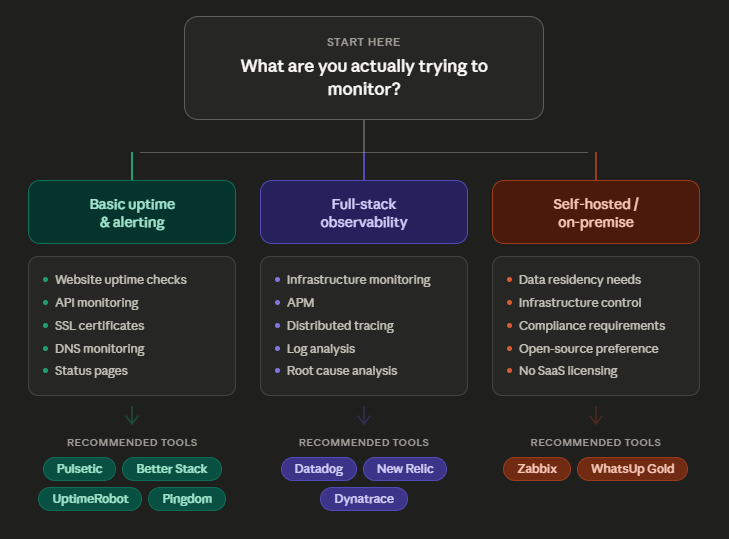
The core question: do you need uptime or observability?
A lot of organizations searching for a Site24x7 alternative are really trying to answer a different question.
Do you need a lightweight uptime monitoring platform, or do you need full-stack observability across infrastructure, applications, logs, and services?
Those are very different categories of software.
If your primary goal is monitoring, then a full observability platform may add unnecessary complexity and cost. In many cases, organizations end up paying for infrastructure monitoring, tracing, cloud telemetry, and advanced dashboards they rarely use.
This is where platforms like UptimeRobot, Better Stack, and Pingdom tend to make more sense. They focus heavily on uptime monitoring, alerting, and operational simplicity.
On the other hand, some organizations rely heavily on:
- Infrastructure monitoring
- Application performance monitoring
- Distributed tracing
- Log analysis
- Root cause analysis
For those environments, replacing Site24x7 with a lightweight uptime tool would create major visibility gaps. Platforms like Datadog, New Relic, and Dynatrace are designed specifically for deeper observability across complex systems and cloud infrastructure.
There is also a third category of users moving away from SaaS monitoring platforms entirely. Some organizations prefer self-hosted or fully on-premise monitoring for infrastructure control, compliance, or data residency requirements. With these users, platforms like Zabbix and WhatsUp Gold have found their audience.
Note: Pricing, feature availability, and plan limits for monitoring platforms change frequently. Always verify current pricing and feature details directly with the vendor before making a decision.
The best alternatives for simple uptime and alerting
Not every organization replacing Site24x7 needs another all-in-one observability platform.
In many cases, teams primarily want reliable uptime monitoring for websites, APIs, SSL certificates, DNS records, and status pages without navigating layers of infrastructure dashboards or complex configuration menus.
For those environments, cleaner workflows and faster setup often matter more than deep telemetry or advanced observability features.
1. UptimeRobot
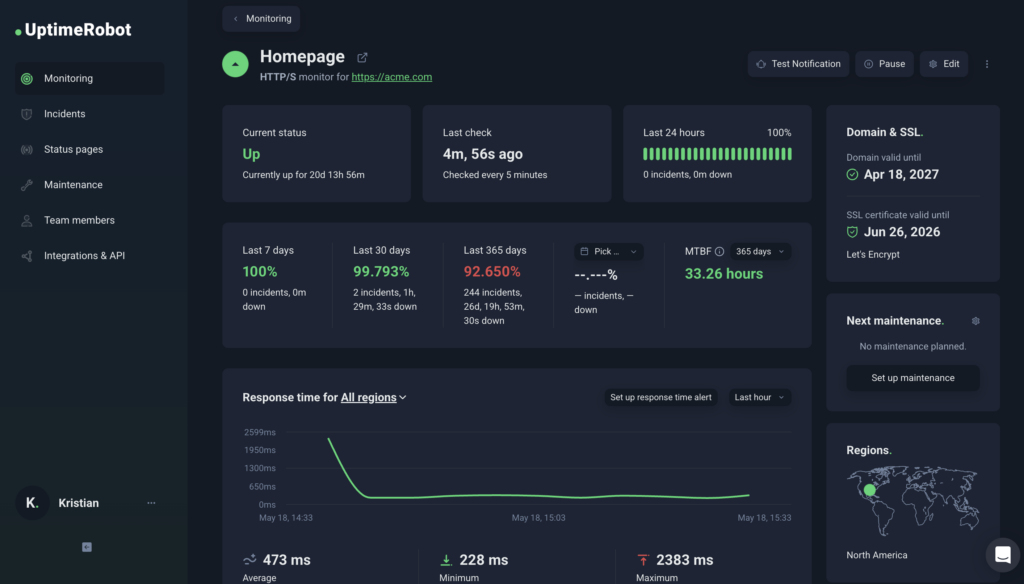
Best for: Teams that want a simple external monitoring layer with a generous free plan with 5 minute intervals and minimal setup overhead
UptimeRobot remains one of the most widely used uptime monitoring platforms, with more than 3.1 million users globally, partly because it stays focused on reliable uptime monitoring.
While Site24x7 tries to cover nearly every category of monitoring, UptimeRobot intentionally keeps things simpler.
It’s designed around fast setup, reliable alerting, and straightforward uptime visibility without requiring teams to manage complex infrastructure dashboards, observability modules, or complicated workflows they may never use.
That simplicity is exactly why UptimeRobot is commonly used by developers, DevOps teams, agencies, support teams, and smaller businesses that need reliable external monitoring without the overhead of a larger observability platform.
UptimeRobot multiple features covering most of your monitoring needs:
- Website & endpoint monitoring
- API monitoring
- SSL expiry & errors monitoring
- DNS monitoring
- Ping monitoring
- Port monitoring
- Cron job (heartbeat) monitoring
- UDP monitoring
- Response time monitoring
- Keyword monitoring
- Domain monitoring
- Customizable status pages
The platform also supports a wide range of alerting integrations, including Slack, Microsoft Teams, Discord, Telegram, PagerDuty, webhooks, SMS, and voice calls.
One of UptimeRobot’s biggest advantages is accessibility. The Free plan includes up to 50 monitors with 5-minute checks, making it easy for smaller teams to set up external monitoring without committing to enterprise pricing or complicated onboarding.
Monitoring intervals go as low as every 30 seconds, and paid plans start at just $7/month.
For teams that mainly want to know:
- Is the website up?
- Is the API responding?
- Did the SSL certificate expire?
- Did a cron job fail?
…UptimeRobot usually feels much lighter and easier to manage than broader observability platforms, particularly for teams that value fast setup, bulk monitor imports, and simpler monitoring workflows.
The tradeoff is that it is not trying to replace enterprise observability tooling. Teams needing deep infrastructure analytics, distributed tracing, or advanced APM workflows will likely need a different category of platform entirely.
Organizations that want reliable uptime monitoring without unnecessary operational overhead find that UptimeRobot hits a very practical middle ground between simplicity, affordability, and functionality.
| Pros | Cons |
| Free plan includes 50 monitors with 5-minute checks | Not designed for deep observability or APM |
| Fast setup with no credit card required | Less infrastructure visibility than enterprise platforms |
| Supports website, API, SSL, domain, response-time, DNS, ping, port, cron, and UDP monitoring | Advanced analytics and tracing are limited |
| Bulk monitor imports simplify large uptime deployments | May feel too lightweight for large enterprise environments |
| 17+ integrations including Slack, Teams, Discord, PagerDuty, Telegram, webhooks, SMS, and voice alerts | Fewer cloud-native observability features than Datadog or Dynatrace |
| iOS and Android apps and broad support access help smaller teams manage monitoring quickly |
If your team is mainly using Site24x7 for uptime checks and alerting rather than full-stack observability, UptimeRobot’s free plan is an easy place to start.
2. Better Stack
Best for: Teams that want faster alerting and modern incident response workflows
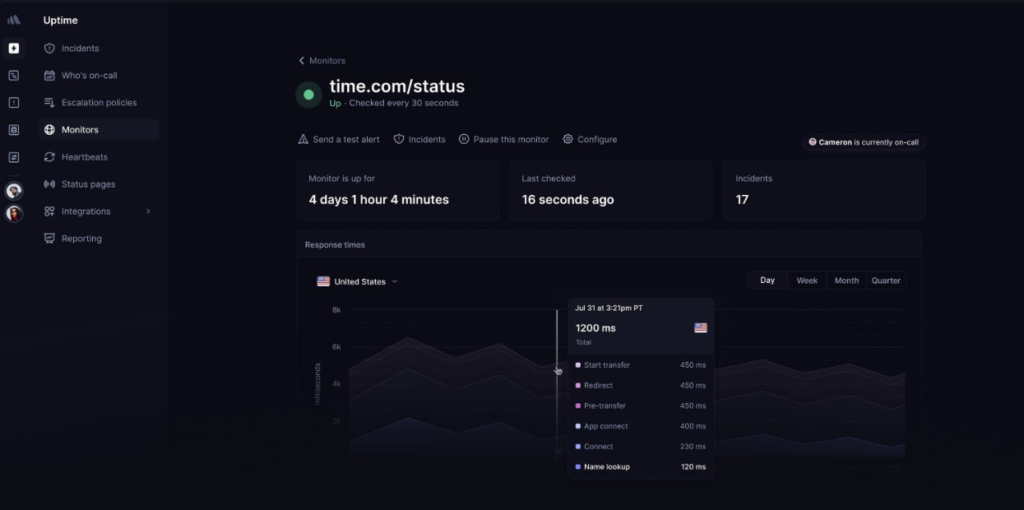
Better Stack approaches monitoring a little differently from traditional uptime tools. Instead of focusing only on checks and alerts, it combines uptime monitoring with incident management, on-call scheduling, escalations, and team coordination.
That operational focus is one reason it has become popular with modern SaaS and DevOps teams. For organizations frustrated with Site24x7’s alerting workflows or SMS/voice credit systems, Better Stack’s more generous and non-credit-based alerting model is a major selling point.
The platform also emphasizes speed. Monitoring checks can run as frequently as every 30 seconds, and the interface feels noticeably more modern and streamlined than older monitoring platforms.
Better Stack works well for teams managing customer-facing services where rapid alert delivery and incident coordination matter just as much as uptime visibility itself.
Core features include:
- Uptime monitoring
- Incident management
- On-call scheduling
- Status pages
- Escalation policies
- Slack, Teams, PagerDuty, and webhook integrations
Rather than trying to become a giant all-in-one monitoring suite, Better Stack focuses on operational workflows and incident response. That makes it a strong fit for teams that care more about fast alerts and coordination than deep infrastructure analytics.
| Pros | Cons |
| Less reliance on credit-based alerting models | Less infrastructure depth than observability platforms |
| Fast monitoring intervals | Can be excessive for very small teams |
| Strong incident management tooling | Not designed for advanced APM |
| Modern UI and workflows | Pricing scales with operational features |
The best alternative for synthetic monitoring and reporting
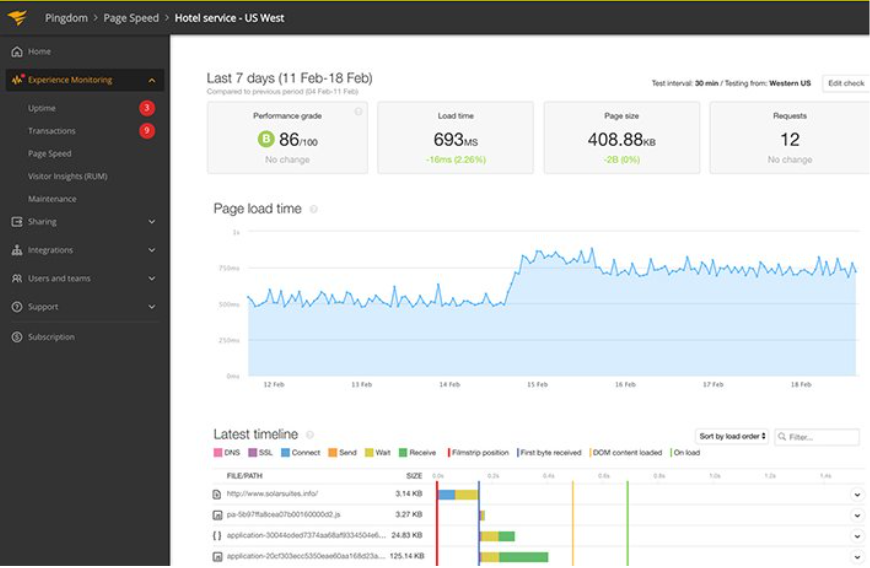
Pingdom sits between lightweight uptime monitoring tools and full observability platforms. It is best known for synthetic monitoring, transaction checks, and polished reporting workflows aimed at customer-facing teams.
3. Pingdom by SolarWinds
Best for: Teams that care more about polished reporting and synthetic monitoring than all-in-one infrastructure tooling
Pingdom has stayed relevant for years because it solves a very specific problem well: making uptime and performance monitoring easy to understand, present, and report on.
While many Site24x7 users complain about cluttered workflows and overloaded dashboards, Pingdom focuses on uptime visibility, synthetic transaction monitoring, page speed insights, and customer-facing reporting rather than trying to become a giant infrastructure operations suite.
That makes it especially popular with:
- Agencies
- Customer-facing SaaS teams
- Teams managing public dashboards
- Organizations monitoring user experience and transaction flows
One of Pingdom’s biggest strengths is synthetic monitoring. Teams can simulate user interactions and monitor transaction paths rather than only checking whether a server responds.
Combined with strong historical reporting and polished dashboards, that gives Pingdom a much more presentation-friendly feel than many traditional monitoring platforms.
The downside is cost. Pingdom is noticeably more expensive than lightweight uptime tools like UptimeRobot, especially for smaller teams that mainly need basic checks and alerting.
It also sits in an awkward middle ground for some organizations:
- More advanced and reporting-focused than simple uptime tools
- Much less comprehensive than full observability platforms like Datadog or Dynatrace
For teams frustrated with busy interfaces and looking specifically for synthetic monitoring, reporting, and cleaner uptime workflows, Pingdom remains one of the stronger alternatives in this category.
| Pros | Cons |
| Strong synthetic monitoring | Higher pricing than lightweight tools |
| Excellent reporting and dashboards | Limited observability depth |
| Good customer-facing visibility | Can feel excessive for basic uptime checks |
| Polished UI | Not built for advanced infrastructure analytics |
The best alternatives for full-stack observability
Datadog, New Relic, and Dynatrace target teams managing large cloud environments, distributed systems, and application performance across complex infrastructure.
These platforms go much further into observability, tracing, and infrastructure analytics than traditional uptime monitoring tools.
4. Datadog
Best for: Teams that have outgrown basic monitoring and need deep visibility across infrastructure, applications, logs, and cloud services
Datadog is what many teams move to once Site24x7 starts feeling limiting rather than overwhelming.
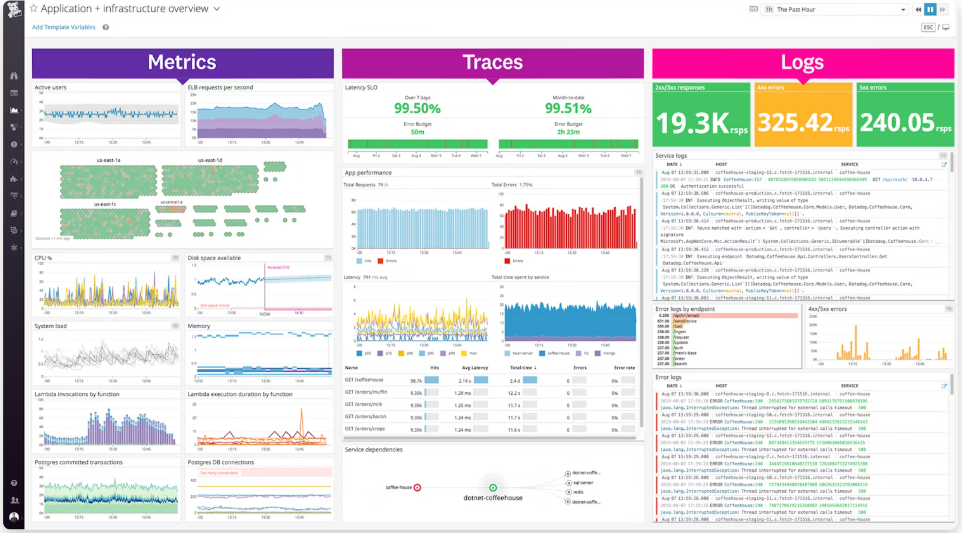
This is not a simple uptime tool. Datadog is built for organizations running complex cloud infrastructure, microservices, containers, Kubernetes clusters, and distributed applications where basic uptime checks are only a tiny part of the monitoring picture.
The biggest advantage over Site24x7 is depth. Datadog’s dashboards, integrations, telemetry, and infrastructure visibility are widely considered stronger and more flexible, especially in large cloud-native environments. It’s particularly popular with DevOps, platform engineering, and SRE teams that need to centralize monitoring across multiple systems and services.
Datadog combines:
- Infrastructure monitoring
- APM
- Distributed tracing
- Log management
- Cloud monitoring
- Real user monitoring
- Synthetic monitoring
…inside a single ecosystem with a massive integration library.
The downside is cost. Datadog’s pricing can scale quickly once logs, traces, synthetic tests, and ingestion volumes start growing. Smaller teams looking mainly for uptime checks and alerts will usually find it unnecessarily expensive and operationally heavy.
But for organizations already deep into cloud infrastructure and observability workflows, Datadog is one of the clearest “step up” alternatives to Site24x7 rather than just a simpler replacement.
| Pros | Cons |
| Extremely deep observability | Expensive at scale |
| Excellent dashboards and integrations | Steeper learning curve |
| Strong cloud-native monitoring | Overkill for basic uptime monitoring |
| Powerful APM and tracing | Usage-based pricing can become hard to predict |
5. New Relic
Best for: Engineering-heavy teams focused on application performance and developer troubleshooting workflows
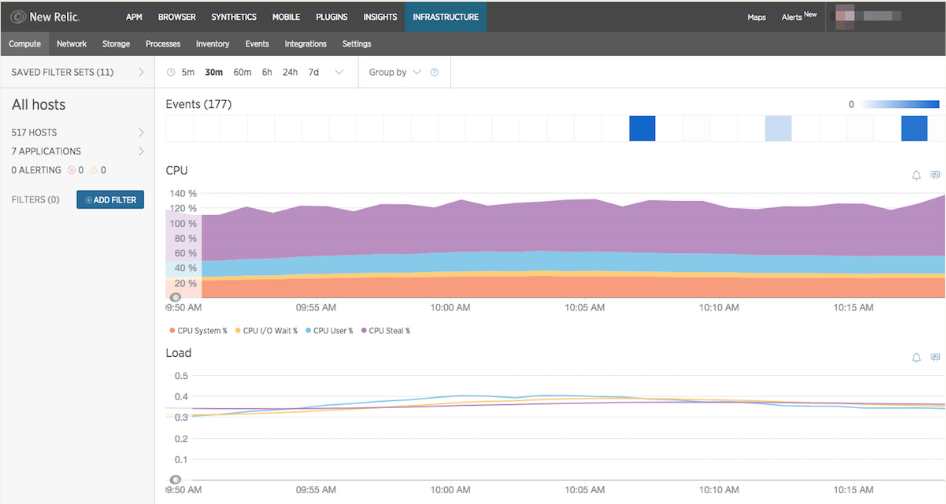
New Relic leans more heavily into developer-centric observability than many traditional monitoring platforms.
While Site24x7 tries to balance several use cases at once, New Relic is much more focused on helping engineering teams understand what is happening inside applications and services.
That makes it an attractive choice for organizations managing:
- Distributed systems
- Cloud-native applications
- Performance-sensitive services
- Large telemetry environments
New Relic’s strongest area is application visibility. The platform gives developers detailed telemetry, tracing, logs, and performance data that make debugging and bottleneck analysis significantly easier in complex environments.
Compared to Site24x7, the workflows generally feel more engineering-focused and less IT-operations-oriented.
Like Datadog, New Relic can become expensive as ingestion and observability usage grows. Teams that only need uptime monitoring, SSL checks, or basic alerting will likely find the platform far more powerful than necessary.
But for engineering teams prioritizing deep application insights and troubleshooting speed, New Relic remains one of the strongest observability platforms in the market.
| Pros | Cons |
| Strong developer-focused observability | Usage-based pricing can scale quickly |
| Excellent application monitoring | More complex than uptime-focused tools |
| Deep telemetry and tracing | Can feel overwhelming for smaller teams |
| Good cloud-native support | Not ideal for lightweight monitoring use cases |
6. Dynatrace
Best for: Large-scale environments where AI-assisted root cause analysis matters more than lightweight monitoring
Dynatrace is built for organizations managing massive cloud and enterprise environments where manually tracing incidents across infrastructure and services becomes increasingly difficult.
Its biggest differentiator is automation.
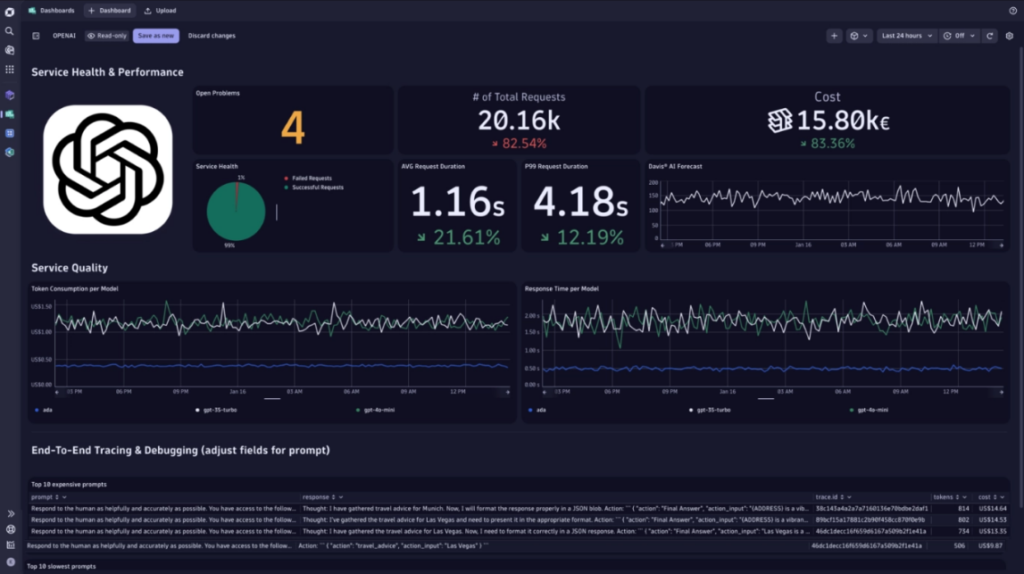
Dynatrace automatically maps dependencies between services, applications, containers, and infrastructure, then uses its broader Davis platform, including Davis AI and Davis CoPilot, to assist with troubleshooting, analysis, and root cause investigation during incidents.
The deeper AI-assisted approach is a major reason enterprise teams choose Dynatrace for large cloud and enterprise environments.
Compared to Site24x7, Dynatrace feels much more focused on enterprise observability and operational intelligence rather than broad SMB-friendly monitoring coverage.
It works especially well for:
- Large enterprise environments
- Kubernetes-heavy infrastructure
- Complex distributed systems
- Organizations consolidating multiple monitoring tools
The platform is also known for strong cloud-native visibility and detailed infrastructure mapping, though that depth comes with more complexity and cost than simpler monitoring platforms.
Dynatrace is not designed for teams that only need uptime checks, status pages, or lightweight alerting. It is built for organizations trying to reduce troubleshooting time across very large systems where outages and performance issues can involve dozens of interconnected services.
| Pros | Cons |
| Strong AI-driven root cause analysis | Premium enterprise pricing |
| Excellent infrastructure mapping | Can feel overwhelming for smaller teams |
| Deep cloud-native observability | More complex than lightweight monitoring tools |
| Strong Kubernetes and enterprise visibility | No strong free-tier option |
The best on-premise and open-source alternatives
Some teams want to leave SaaS monitoring entirely and run everything in-house instead.
For organizations prioritizing infrastructure control, customization, compliance, or data residency, self-hosted and on-premise platforms like Zabbix and WhatsUp Gold offer much more control than cloud-first monitoring tools.
7. Zabbix
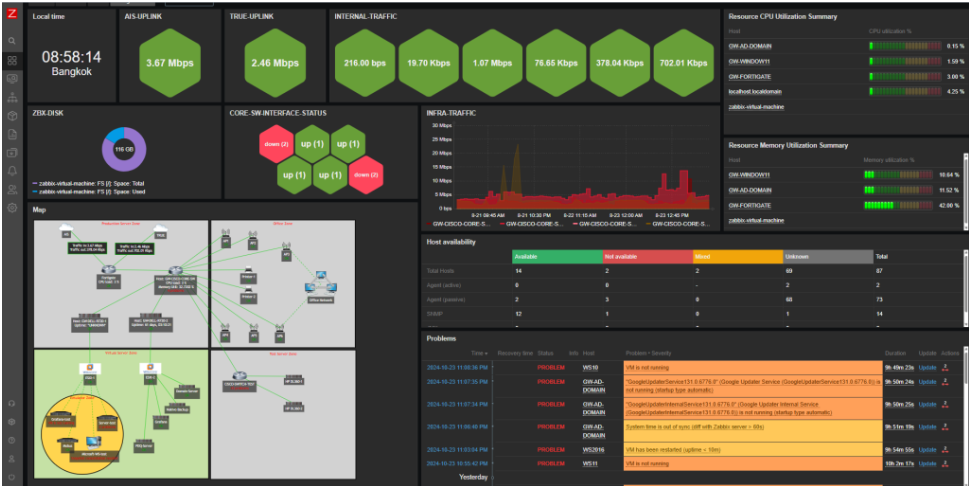
Best for: Sysadmins and infrastructure teams that want complete control over their monitoring stack
Zabbix is one of the most established open-source monitoring platforms in the market and remains a popular choice for teams that want to run monitoring infrastructure entirely on their own systems.
Unlike SaaS monitoring platforms, Zabbix gives organizations full control over deployment, storage, customization, integrations, and scaling. The flexibility is a major reason it is widely used in enterprise infrastructure, MSP, network monitoring, and compliance-heavy environments.
Zabbix supports monitoring across:
- Servers and virtual machines
- Networks and bandwidth
- Applications and databases
- Cloud infrastructure
- SNMP, IPMI, and custom metrics
The tradeoff is operational overhead.
Running Zabbix properly is a fairly significant infrastructure commitment compared to cloud-hosted monitoring tools. Teams are responsible for deployment, upgrades, database management, proxies, agents, scaling, backups, and ongoing maintenance.
For experienced sysadmins, that level of control is a major advantage. For smaller teams without dedicated infrastructure resources, it can become difficult to manage quickly.
The interface also feels more technical and less polished than newer SaaS monitoring platforms, especially for teams primarily looking for simple uptime checks and alerting.
Still, for organizations prioritizing infrastructure ownership, open-source flexibility, and long-term customization, Zabbix remains one of the strongest self-hosted alternatives to Site24x7.
| Pros | Cons |
| Fully open-source and self-hosted | Significant setup and maintenance overhead |
| Extremely customizable | Steeper learning curve |
| No SaaS licensing model | Requires database, agent, and proxy management |
| Strong infrastructure and network monitoring | UI feels more technical than modern SaaS tools |
8. WhatsUp Gold
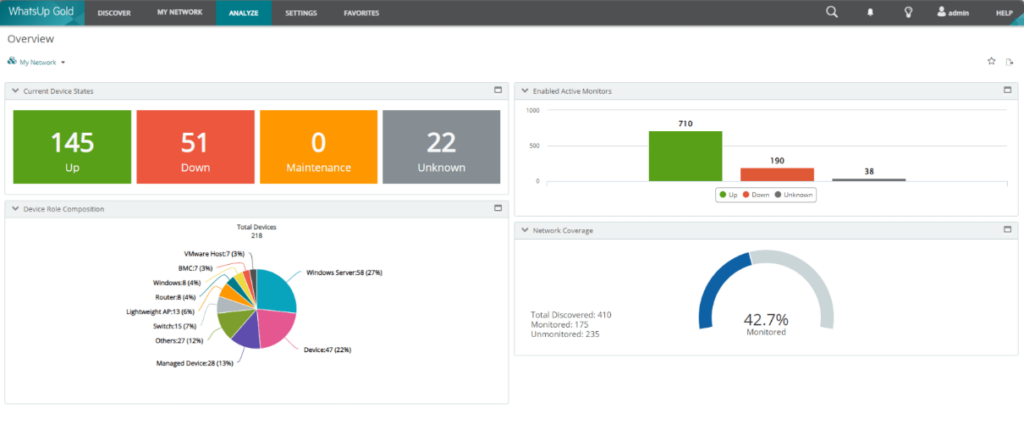
Best for: Traditional IT environments that need fully on-premises monitoring and strict data residency control
WhatsUp Gold is aimed at organizations that want commercial monitoring software without relying on SaaS infrastructure.
While much of the monitoring industry has shifted toward cloud-first observability platforms, many enterprises still operate in environments where keeping monitoring data fully in-house matters for compliance, security, or operational reasons.
That is the audience WhatsUp Gold continues to serve.
The platform focuses heavily on:
- Network monitoring
- Device discovery
- Infrastructure visibility
- Traffic analysis
- On-premises deployment
Compared to Site24x7, the biggest advantage is control. Organizations can keep monitoring infrastructure entirely within their own environment rather than routing operational data through a third-party cloud provider.
WhatsUp Gold is especially common in:
- Traditional enterprise IT environments
- Compliance-heavy industries
- Internal infrastructure teams
- Organizations standardizing around on-premises tooling
The downside is that the platform feels more traditional than newer cloud-native monitoring tools. Teams heavily invested in Kubernetes, containers, distributed tracing, and modern observability workflows will likely find platforms like Datadog or Dynatrace more aligned with their infrastructure.
For organizations prioritizing local deployment, infrastructure ownership, and commercial support, WhatsUp Gold remains a strong alternative outside the SaaS monitoring ecosystem.
| Pros | Cons |
| Fully on-premises deployment | Older-style interface |
| Strong network visibility | Less cloud-native functionality |
| Commercial support available | More traditional workflows |
| Good fit for compliance-heavy environments | Less suited for modern observability use cases |
Next steps
The right Site24x7 alternative usually becomes clearer once you stop comparing feature lists and start looking at operational needs.
If your team mainly needs reliable uptime monitoring, fast alerts, and simpler workflows, moving to a lighter platform can reduce a surprising amount of operational friction.
If you are managing cloud infrastructure, distributed systems, and application performance at scale, deeper observability platforms may be worth the added complexity and cost.
And for organizations prioritizing infrastructure ownership or compliance, self-hosted and on-premise tools still have a strong place in the market.
Before switching, it is worth identifying:
- What your team actually monitors day to day
- Which Site24x7 workflows frustrate you most
- Whether you are overbuying observability features you rarely use
- How important deployment control, alerting, and reporting are to your operations
Once those answers are clear, narrowing down the right replacement becomes much easier.
If your team is primarily focused on uptime monitoring, alerting, SSL checks, DNS monitoring, and public status pages, creating a free UptimeRobot account is a simple way to test whether a lighter monitoring workflow fits your environment better.
FAQs
What is the best Site24x7 alternative for uptime monitoring?
The best Site24x7 alternative depends on how much monitoring complexity your team actually needs. For lightweight uptime monitoring, platforms like UptimeRobot, Better Stack, and Pingdom are often easier to manage than broader observability suites.
UptimeRobot is a strong fit for teams that want fast setup, reliable external monitoring, and a generous free plan with 50 monitors and 5-minute intervals without requiring a credit card. Better Stack is more focused on operational workflows and incident coordination, while Pingdom is known for synthetic monitoring and reporting features.
Which Site24x7 alternative is best for observability and APM?
Datadog, New Relic, and Dynatrace are generally stronger choices for full-stack observability, application performance monitoring, distributed tracing, and infrastructure visibility.
Is there a free alternative to Site24x7?
Zabbix is one of the most widely used free and open-source alternatives. UptimeRobot also offers a free plan for lightweight uptime monitoring and alerting.
Which Site24x7 alternative is best for self-hosted monitoring?
Zabbix is a popular self-hosted monitoring platform for infrastructure and network monitoring. WhatsUp Gold is another option for organizations wanting commercial on-premise monitoring software.
Is Site24x7 good for small businesses?
Site24x7 can work well for small businesses that want broad monitoring coverage across infrastructure, applications, networks, logs, and cloud services within a single platform.
However, many smaller teams only need reliable uptime monitoring, SSL checks, DNS monitoring, status pages, and alerting. In those cases, lighter platforms like UptimeRobot are often easier to set up and manage because they offer simpler workflows, lower pricing, minimal learning curves, and generous free plans with features like 5-minute monitoring intervals and no-credit-card setup.