What is Uptime?
Uptime is the proportion of a defined period during which a website or service is available.
For a time-based measurement, the calculation is:
Uptime (%) = (available time ÷ total measured time) × 100
For example, if a website is unavailable for 30 minutes during a 30-day month, its uptime is approximately 99.93%.
The measurement needs a clear scope. A homepage responding successfully does not necessarily mean every checkout, login or other function works.
For a detailed walkthrough, see our guide to calculating uptime.
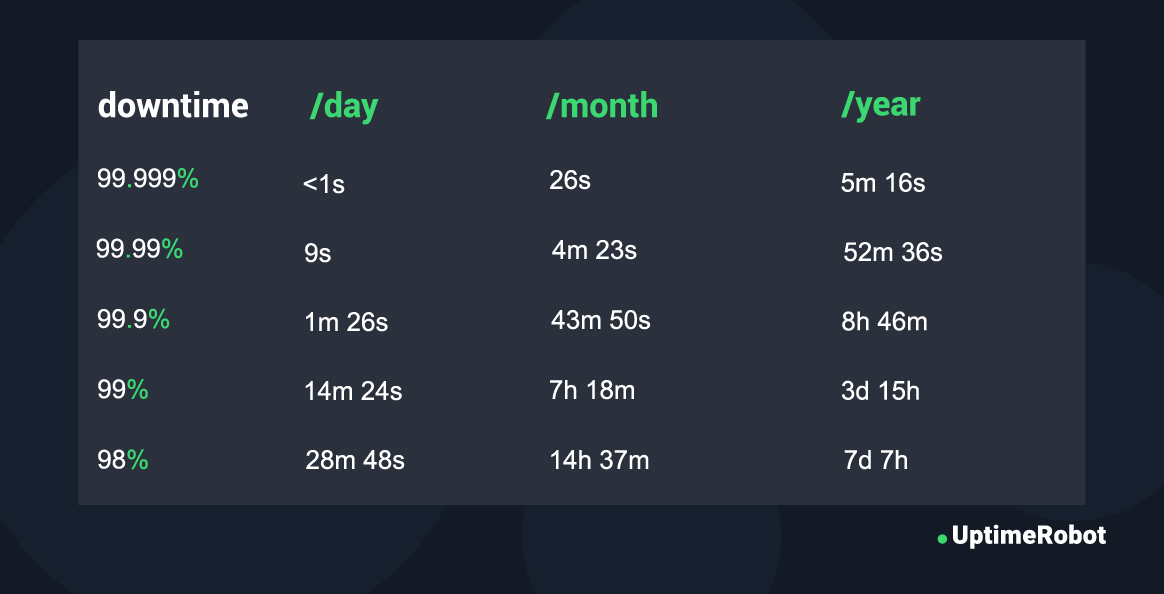
Uptime percentages translated into downtime
Each additional nine reduces the downtime allowance by a factor of ten.
| Uptime target | Downtime per 30-day month | Downtime per 365-day year |
|---|---|---|
| 99% | 7 hours 12 minutes | 3 days 15 hours 36 minutes |
| 99.9% — three nines | 43 minutes 12 seconds | 8 hours 45 minutes 36 seconds |
| 99.99% — four nines | About 4 minutes 19 seconds | About 52 minutes 34 seconds |
| 99.999% — five nines | About 26 seconds | About 5 minutes 15 seconds |
These are mathematical allowances for the stated periods. An SLA may define a different measurement window or exclude particular events.
What does 99.9% uptime mean?
99.9% uptime means a service is available for 99.9% of the measured period. The remaining 0.1% is its downtime allowance.
That works out to roughly 43 minutes in a 30-day month or 8 hours 45 minutes in a 365-day year.
Several short outages can consume the allowance just as readily as one longer incident. To understand the experience behind the percentage, look at incident frequency, duration and timing alongside total uptime.
What does 99.99% uptime mean?
99.99% uptime allows one-tenth as much downtime as 99.9%. Over a 365-day year, that is about 53 minutes. Over a 30-day month, it is roughly four minutes and 19 seconds.
A single hour-long outage would exceed the entire annual allowance for 99.99%, even if the website remained available for the rest of the year.
The reporting period matters, too. A website can meet an annual target while missing the same percentage target in an individual month.
What does 99.999% uptime mean?
99.999% uptime is commonly called “five nines.” It allows just over five minutes of downtime per 365-day year, or approximately 26 seconds in a 30-day month.
At that level, even a short interruption can consume a substantial share of the allowance. Detection, recovery and the availability of dependencies all matter.
Whether five nines is an appropriate target depends on what an interruption means for the business and its customers. Set the target around those needs, then assess what it takes to achieve and measure it.
How do monitored websites compare with these targets?
In UptimeRobot’s analysis of the 12 months ending 30 September 2026, the typical monitored website recorded 2 to 4 hours of downtime, measured by the median.
The median is the middle value when websites in each group are ordered by their recorded downtime. It describes a typical website more usefully here than the mean, which was about five days and was pulled upward by websites that were down for weeks.
| Finding | Result |
|---|---|
| Median downtime during the year | 2–4 hours |
| Monitored websites exceeding the roughly 8 hours 45 minutes allowed by 99.9% uptime | 3–4 in 10 |
| Monitored websites exceeding the roughly 53 minutes allowed by 99.99% uptime | 56–70% |
The lower end of each range includes every website in the analysis. The upper end includes only websites that sent an alert in the preceding two years. The ranges reflect those two groups.
For both groups, median downtime fell within the annual allowance for 99.9%, but exceeded the tighter allowance for 99.99%.
Across the two groups, 56–70% of monitored websites exceeded the annual downtime allowance for four nines. Three to four in every ten exceeded even the three-nines allowance.
These results describe websites UptimeRobot monitors, not all websites.
The comparisons use annual downtime allowances. They do not establish whether a website breached an SLA, which depends on the agreement’s measurement period, scope and exclusions.
What to check in an uptime SLA
An uptime SLA should make the target measurable. Before comparing a recorded percentage with a promise, check:
- What is covered: the website, a specific endpoint, or a defined service.
- The reporting period: a calendar month, a year, or another agreed window.
- How availability is measured: including the monitoring source and what counts as a failed check.
- What is excluded: such as agreed maintenance windows.
- How results are reviewed: including the process for reporting a missed target.
Keep comparisons consistent. A monthly commitment should be assessed against that month’s results, rather than an annual percentage.
Measure uptime against the target that matters to you
A target gives you something to aim for. Monitoring gives you a record to compare against it.
Use UptimeRobot to monitor your website’s availability and receive downtime alerts. Review the results over the period that matters to your business, alongside individual incidents.
Choose your uptime target based on the consequences of downtime for your customers and your business. Then use a consistent measurement period and clear rules to assess whether your website meets it.
The Impact of Downtime
Downtime can wield a devastating blow to businesses. Aside from the immediate loss of sales or productivity, there’s also the potential damage to a company’s reputation and customer trust to consider. In a world where consumers expect constant availability, service interruptions can lead to customer churn and negative reviews.
A glaring example of this was the Amazon outage in 2013. The interruption lasted for a mere 30 minutes, but the estimated loss in sales was nearly $2 million. That’s a stark reminder of the high stakes of maintaining uptime.
A 2016 study by the Ponemon Institute found that the average total cost of a data center outage in the US was $740,357. This figure accounts for not just direct loss of revenue, but also the time and money spent on dealing with reduced productivity from end-users, expenses to replace faulty equipment, detection and recovery, and the potential harm to the company’s reputation.
Strategies for Achieving Higher Uptime
So how can businesses strive for that elusive 99.99% availability? For starters, by investing in proper backup systems that can take over when there’s a service interruption. For 99.99% SLA, this could mean having extra servers, databases, network paths, and even power supplies available.
Regular maintenance and system updates also play a key role in maintaining high uptime. Outdated software or hardware can be prone to failures, and neglecting updates can leave systems vulnerable to cyberattacks, which can lead to downtime. Routine checks and maintenance help identify potential issues before they cause service interruptions.
Investing in quality infrastructure and services is another essential step towards achieving higher uptime. Outdated data center servers are more likely to experience a service interruption, increasing the risk of downtime.
Understanding what 99.9% uptime really means can be tricky business. While it might seem close to perfect, that tiny 0.1% can equate to substantial potential downtime in the grand scheme of things. In the digital world, where every minute of service disruption can translate to thousands of dollars lost, striving for higher uptime can make a world of difference.
FAQs
Is 99.9% uptime good?
It depends on the service and the consequences of downtime. It allows about 43 minutes of unavailability in a 30-day month. Decide whether that allowance fits your customers’ needs before choosing it as a target.
What is the difference between 99.9% and 99.99% uptime?
99.99% allows one-tenth of the downtime permitted by 99.9%. Over a 365-day year, the allowance falls from about 8 hours 45 minutes to about 53 minutes.
How much downtime does five nines allow?
Five nines, or 99.999% uptime, allows about five minutes and 15 seconds of downtime over a 365-day year.
Does planned maintenance count as downtime?
Check the measurement rules. An SLA may exclude agreed maintenance even though customers experience the service as unavailable during that time.
How much downtime does a typical monitored website experience?
In UptimeRobot’s analysis of the 12 months ending 30 September 2026, median downtime was 2 to 4 hours. The lower figure includes every website in the analysis; the higher figure includes websites that sent an alert in the preceding two years.