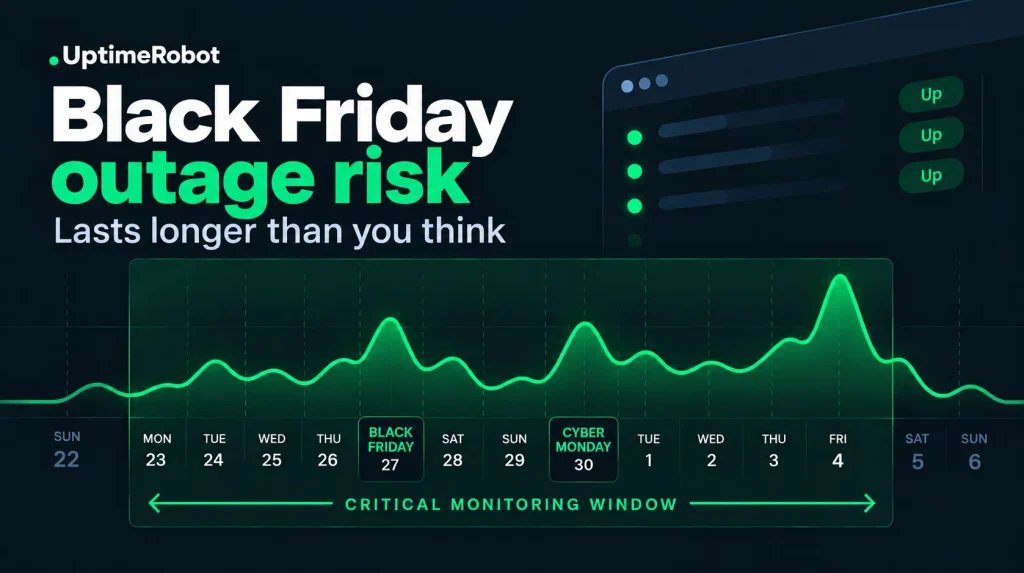
Black Friday and Cyber Monday get most of the attention during the holiday season, but they don’t define the full risk window.
UptimeRobot and IsDown (recently acquired by UptimeRobot) data from the last two Black Friday periods shows that problems can keep coming after the dates everyone has circled on the calendar.
For 2026, that means treating November 23 to December 4 as the critical monitoring window, not just Black Friday and Cyber Monday.
Keeping your own infrastructure healthy doesn’t mean everything your store depends on will stay healthy with it.
So how long do you need to stay on high alert, and what should you be watching? We dug into two years of monitoring and provider incident data to find out.
Key takeaways
- 24 of 24 days ran above baseline. Both 12-day Black Friday windows recorded elevated failures every day.
- The worst day moves every year. Black Friday ranked only 6th of 12 in 2024 and 11th of 12 in 2025. Cyber Monday topped the 2024 window at +29.8%, while December 5 topped 2025 at +46.7%.
- The problem might not be yours. The largest 2025 spike coincided with a Cloudflare incident four days after Cyber Monday. Monitoring your own infrastructure isn’t enough when DNS, CDNs, payments, authentication and other third party services can take the customer journey down with them.
- SMS delivery delays can spike even when your store stays online. On Cyber Monday 2025, six SMS providers reported delivery delays, compared with just one on a typical weekday between June and December.
The 12 days of elevated incidents
We looked at our own monitoring data across two 12-day periods, starting on the Monday of Black Friday week in 2024 and 2025.
Every day during those periods, we detected higher rates of failures across monitored websites, APIs and online services.
| Period | vs. weekday-matched baseline | Days above baseline |
| Nov 25 to Dec 6 2024 | +20.2% | 12 of 12 |
| Nov 24 to Dec 5 2025 | +9.8% | 12 of 12 |
The average lift was 20.2% in 2024 and 9.8% in 2025.
With failures remaining elevated throughout both 12-day windows, monitoring, alert coverage and incident response need to stay in place well beyond Black Friday and Cyber Monday.
You can’t pick the bad day in advance
Knowing the risk lasts for 12 days still doesn’t tell you which of those days will be the worst.
| Day | 2024 | 2025 |
| Black Friday | +21.1%, 6th of 12 | +2.4%, 11th of 12 |
| Cyber Monday | +29.8%, 1st of 12 | +4.5%, 8th of 12 |
| Worst day | Cyber Monday, +29.8% | Friday, Dec 5, +46.7% |
Cyber Monday went from the worst day in 2024 to the eighth worst in 2025. Black Friday wasn’t the peak in either year.
Two years of data can’t tell us which day will see the biggest spike in 2026. That makes the full window the safer unit to plan around, rather than trying to identify a handful of high-risk days in advance.
Four days after Cyber Monday, the biggest spike arrived
December 5 shows what can happen when a major third party service runs into trouble during that extended risk window.
At 08:47 UTC, a change to Cloudflare’s web application firewall started returning errors for customers that account for about 28% of the HTTP traffic it serves. Cloudflare fixed the issue by 09:12, according to its postmortem.
Failures detected by UptimeRobot surged at the same time. A normal hour sees roughly 30,000 failures. The 08:00 hour recorded around 184,000, followed by another 179,000 in the 09:00 hour.
Cloudflare and Shopify also reported incidents during that period:
| Time (UTC) | Provider | Status update | Duration |
| 08:56 | Cloudflare | Service Issues | 27 min |
| 09:10 | Shopify | Interruption in service | 10 min |
| 09:16 | Shopify | Interruption in service | 52 min |
IsDown saw the same broader spike in provider incidents. New incidents rose from around 15 in a normal hour to 158 during the 08:00 hour and 451 during the 09:00 hour.
Of the 562 incidents that began between 08:40 and 09:30, 193 mentioned Cloudflare.
By 10:00, UptimeRobot-detected failures were back near normal levels. But December 5 still finished with approximately one million failures, 46.7% above baseline and the highest of the entire 2025 Black Friday period.
The timing doesn’t prove that Cloudflare caused every failure. What it shows is how quickly a problem at one major provider can line up with a spike of hundreds of thousands of failures.
If you stopped treating the period as high risk after Cyber Monday, you would have stopped four days too early.
Your stack can be healthy and your store can still have problems
Load testing, deployment freezes and extra capacity can prepare the infrastructure you control. Checkout depends on infrastructure you don’t control too.
| Layer | Example providers | What the customer sees when it breaks | How to watch it |
| DNS | Cloudflare, AWS Route 53 | Your site may not load at all | Use DNS monitoring to check that your domain continues resolving correctly |
| CDN | Cloudflare, Fastly, Akamai | Pages, images or other assets may load slowly or fail | Use third party monitoring to track your CDN provider alongside your own infrastructure |
| E-commerce platform | Shopify, BigCommerce, WooCommerce infrastructure | Storefronts, carts or checkout may become unavailable | Monitor key store URLs with HTTP monitoring and track external providers with third party monitoring |
| Payment processor | Stripe, PayPal, Adyen | Customers reach checkout but can’t complete payment | Track payment providers with third party monitoring and monitor checkout endpoints where applicable |
| Login and authentication | Auth0, Okta | Customers may be unable to log in, verify their identity or access their account | Use HTTP monitoring for customer-facing login flows and third party monitoring for external authentication providers |
| Transactional email and SMS | Twilio, Vonage, Bandwidth, SendGrid | Order confirmations, password resets or one-time codes may be delayed or never arrive | Use third party monitoring to watch the providers these workflows depend on |
A failure anywhere in that chain can affect customers even when your own infrastructure is healthy. SMS delivery delays during Cyber Monday 2025 show how this can play out.
Six SMS providers reported delivery delays on Cyber Monday, compared with just one on a typical weekday between June and December.
Between 16:48 and 18:44 UTC, Twilio, Bandwidth, Telnyx and Vonage reported delays affecting US carriers. Those incidents remained open for 13 to 59 hours.
| Day (2025) | SMS providers reporting delays | Providers reporting US carrier issues |
| Typical weekday, June–December | 1 | — |
| Black Friday, Nov 28 | 4 | Twilio, Telesign, Vonage |
| Cyber Monday, Dec 1 | 6 | Twilio, Telesign, Bandwidth, Telnyx, Vonage |
Twilio had anticipated delays. At 13:00 UTC on Black Friday, it opened an incident titled Black Friday and Cyber Monday Expected SMS and MMS Delivery Delays, which remained open for approximately four days.
All of these incidents were classified as minor. But for a store, even a minor SMS delay can mean an order confirmation arriving after the customer has contacted support, or a one-time login code arriving after it has expired.
SMS wasn’t the only third-party dependency affected. Payment processing accounted for 13.7% of published provider incidents during the 2025 Black Friday window, compared with 10.2% across the wider period. Cloud platforms and e-commerce services also accounted for a larger share.
| Provider category | Black Friday window | Wider period |
| Payment processing | 13.7% | 10.2% |
| Cloud platforms | 5.0% | 4.0% |
| E-commerce | 3.8% | 3.2% |
These figures show each category’s share of published incidents, not its failure rate or reliability. A provider that publishes more incidents isn’t necessarily less reliable than one that publishes fewer.
Your storefront can be completely healthy while a problem with payments, authentication or another dependency still stops a customer from completing a purchase.
Monitoring the storefront alone leaves those failures outside your view.
A quiet status page isn’t a quiet day
Status pages tell you what providers are reporting. Your own monitoring tells you whether the services you depend on are working.
The difference showed up clearly over Thanksgiving and Black Friday 2025. Published provider incidents fell below baseline on both days, while UptimeRobot still detected more failures than usual.
| Day (2025) | Published provider incidents vs. baseline | UptimeRobot-detected failures vs. baseline |
| Thanksgiving, Nov 27 | -34% | +3% |
| Black Friday, Nov 28 | -18% | +2% |
That doesn’t mean providers were failing to report known incidents. The two datasets measure different things. But it does mean that a quiet day on provider status pages doesn’t necessarily mean a quiet day for the systems being monitored.
Shopify’s Cyber Monday incident shows another limitation. The roughly 14-hour incident was classified as minor in its status-page data, despite affecting Admin, Point of Sale, API and Mobile, Support and, at one point, Checkout. Reuters reported that Downdetector reports peaked at more than 4,000 in the US.
Provider status pages are still useful. But during the Black Friday period, they shouldn’t be your only signal. Monitor the services your store depends on directly so you can see when a problem is affecting your own systems and customers.
How to stay covered for all 12 days
The best way to stay prepared is to plan your monitoring around the full 12 day window, and include everything your store depends on.
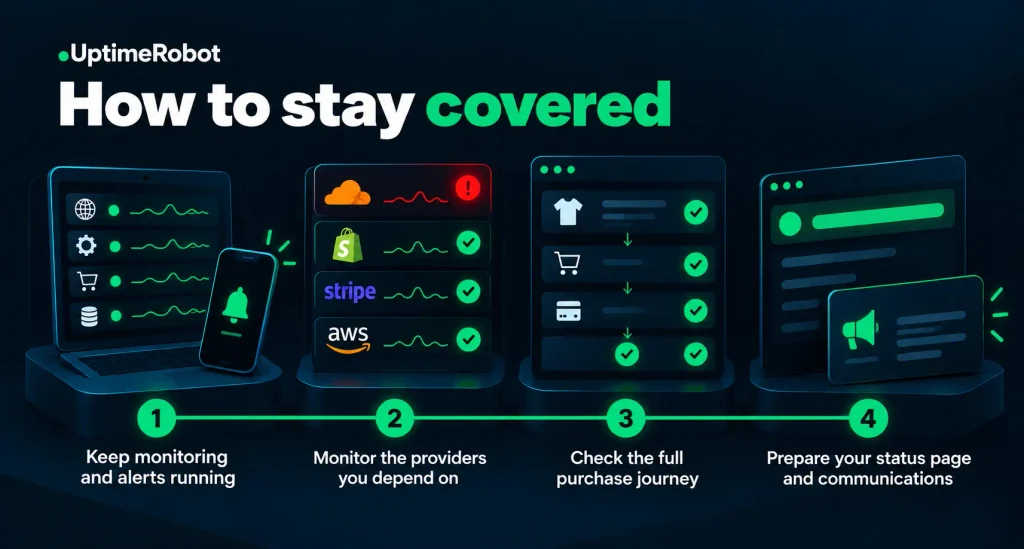
1. Keep full alert coverage for all 12 days
Treat November 23 through December 4 as one continuous high-risk period in 2026.
Check who receives critical alerts throughout the full window, including Thanksgiving weekend and the days after Cyber Monday. The biggest spike in 2025 came on the final day of the equivalent period, so scaling back coverage early could mean missing the day you need it most.
UptimeRobot can send alerts through Slack, Microsoft Teams, SMS, voice calls and PagerDuty.
2. Monitor the providers your store depends on
Your own monitors can be green while a CDN, payment processor or e-commerce provider is having problems.
Third party monitoring tracks more than 6,000 cloud and SaaS providers. Add the services behind your storefront, login and checkout, then select the components you use.
It combines official provider updates with user reports, giving you another signal when problems start upstream. During one AWS incident, UptimeRobot sent an alert 10 minutes before AWS acknowledged the issue.
Third party services have their own allowance and don’t use your regular monitor quota. Paid plans include between 1 and 100 third party services, depending on the plan and monitor tier.
3. Monitor whether customers can buy
A homepage returning 200 OK doesn’t tell you whether checkout works.
Monitor the pages and endpoints a sale depends on. A keyword monitor can confirm that text like “Add to cart” is still present in the HTML of your product pages.
API monitoring can validate JSON, key fields and expected values behind your checkout, catching broken responses, empty results or unexpected messages before they cause bigger problems.
Run those checks alongside third party monitoring. When something breaks, you have signals from both the customer journey and the providers behind it.
4. Be ready to communicate before something breaks
Even good monitoring can’t prevent an upstream outage. It can give you more time to respond.
Set up your status page before the Black Friday window begins. Decide who can update it, who needs to be notified internally and how you’ll communicate when customers are affected.
Then, if an incident hits on Black Friday, Cyber Monday or the Friday after, you’re responding to it instead of setting up your response process from scratch.
Plan for the period, not the day
The harder problem is staying ready when the spike comes somewhere you didn’t expect, or when a provider you don’t control starts affecting customers.
That changes what good preparation looks like. Monitor the purchase journey, watch the third parties behind it and keep the people who need to respond within reach after the headline shopping days are over.
You can’t choose when the next incident hits. You can make sure you’re the first to know when it does.
Add your providers to third party monitoring before November 23 to stay protected during the busiest shopping period of the year.
How we measured
We compared daily incident counts across UptimeRobot monitors with the average for the same weekday during a baseline period starting October 1 and ending before each Black Friday window. The baseline included eight observations for most weekdays and seven for Mondays.
Third party provider incident data comes from IsDown, which tracks more than 6,000 provider status pages.