SSL certificate monitoring tools do much more than send expiry reminders. Depending on the product, they can validate live certificates, test TLS configurations, monitor Certificate Transparency logs, or manage certificate lifecycles across large environments.
We compared 12 tools based on features, pricing, and best fit, from free website monitoring services to enterprise certificate management platforms.
Key takeaways
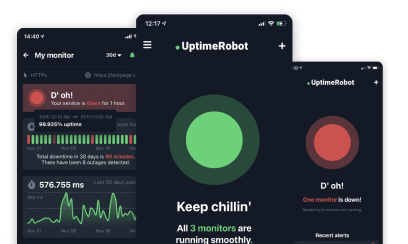
- One monitor from UptimeRobot can alert you to uptime issues, SSL errors, and certificate or domain expiration, eliminating the need for separate monitoring tools.
- Qualys SSL Labs is the free pick for protocol and cipher grading, but it does not provide continuous alerting.
- SSLMate Cert Spotter focuses on Certificate Transparency, which helps catch unauthorized issuance fast.
- Hardenize adds asset discovery, third-party certificate monitoring, and CT ingestion for broader security coverage.
- Datadog, Sematext, Site24x7, Keyfactor, and CyberArk fit teams that need monitoring inside a wider observability or PKI program.
The 12 best SSL certificate monitoring tools: a quick look
The table below is the fast version before the deep dive. All 12 tools, their best-fit use case, starting price, and standout capability, whether you’re shopping for enterprise-grade SSL certificate monitoring software or just want a free checker for one domain.
| Tool | Best-fit use case | Starting price signal | Standout capability |
| UptimeRobot | Public websites and APIs needing uptime, SSL, and domain monitoring in one place | Free (50 monitors; SSL and domain monitoring on paid plans) | One monitor covers uptime, SSL errors, certificate expiration, and domain expiration |
| Domain Scan Tools | Agencies and SMBs wanting domain health in one dashboard | Self-serve, tiers vary | Certificate, DNS, email authentication, and uptime checks in one report |
| Qualys SSL Labs | Free protocol and cipher audits before or after a change | Free | Reference-grade A-F configuration grading |
| Hardenize | Security-conscious estates needing discovery plus posture | Quote-based (Business tier) | Monitors third-party and CT-discovered certificates too |
| SSLMate Cert Spotter | Catching unauthorized certificate issuance fast | $15/month (20 domains) | Certificate Transparency log monitoring with hourly checks |
| Datadog Synthetic Monitoring | Teams already running Datadog observability | Metered within a Synthetics plan | Correlates SSL incidents with existing logs and traces |
| Sematext Synthetics | Developers pairing cert checks with performance data | $2 per HTTP monitor, pay-as-you-go | Certificate change detection every 10 minutes |
| Site24x7 | SMBs and MSPs wanting SSL inside a wider IT suite | Suite pricing, varies by monitor | AWS Certificate Manager integration and Terraform support |
| ManageEngine Key Manager Plus | Enterprises managing internal and private-PKI certificates | Quote-based | Automated procurement, deployment, and renewal |
| DigiCert CertCentral / DigiCert ONE | Organizations standardizing on DigiCert as their CA | Quote-based | CA-led issuance governance built in |
| CyberArk Certificate Manager | Large enterprises with complex machine-identity estates | Quote-based | Built specifically around the 47-day lifecycle shift |
| Keyfactor Command | Enterprises with multi-CA, HSM, or Kubernetes estates | Quote-based | Deep API and connector catalogue for PKI automation |
Why SSL monitoring can’t just be a calendar reminder anymore
Manual certificate tracking used to be manageable. Today, certificate lifetimes are shrinking, automation is becoming the default, and “SSL monitoring” now refers to several different categories of tools. Choosing the right one starts with understanding what problem you’re trying to solve.
Certificate lifetimes are getting much shorter
Public TLS certificate lifetimes are being reduced on a fixed schedule. The CA/Browser Forum adopted Ballot SC-081v3 in 2025, decreasing the maximum validity period from 398 days to 47 days between March 2026 and March 2029.
At the same time, Let’s Encrypt already issues 90 day certificates, recommends automating renewal around day 60, and plans to shorten its own certificates to 64 days in 2027 and 45 days in 2028.
A certificate that once needed attention about once a year may soon require renewal roughly eight times as often. That’s why automation is becoming the standard. Automation replaces expiring certificates, while monitoring confirms the process is still working and alerts you when it isn’t.
“SSL monitoring” means four different things
“SSL monitoring” covers four distinct categories of tools.
- Endpoint monitoring checks the certificate presented by a live website or API and alerts when it is about to expire or becomes invalid.
- TLS testing analyses protocols, ciphers, and configuration to identify security weaknesses.
- Certificate Transparency monitoring watches public CT logs for newly issued certificates associated with your domains.
- Certificate lifecycle management (CLM) discovers, manages, renews, and governs certificates across large internal environments.
A free TLS testing website and a six figure enterprise PKI platform may both be described as SSL monitoring tools, but they serve completely different purposes. Many teams combine these approaches.
The 12 best SSL certificate monitoring tools, reviewed
Every tool below gets the same treatment: what it’s best suited for, its core strengths, its honest limitations, and where it sits against the others. A handful are single-purpose checkers you can set up in minutes. The rest are enterprise platforms that take a procurement cycle, but each gets comparable depth here.
1. UptimeRobot
UptimeRobot combines website monitoring with paid SSL certificate and domain expiration monitoring, so teams can track availability and certificate status from the same account.
Expiry notifications go out 30, 14, seven, and one day before a certificate lapses, and you can layer a fully custom reminder on top of those defaults if you want a different lead time.
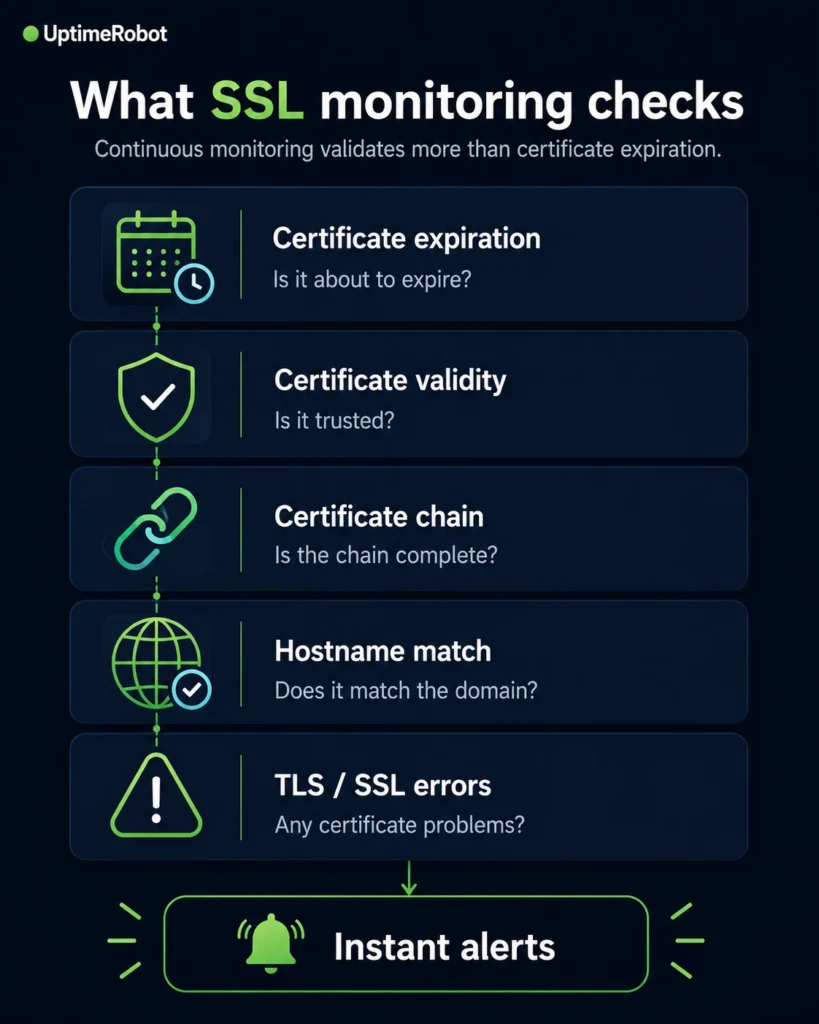
UptimeRobot doesn’t stop at counting down to expiry. It also watches for SSL errors (expired, invalid, or misconfigured certificates) and flips the monitor to DOWN status with a notification the moment one appears.
Alerts travel over email, SMS, and voice call, plus Slack, Zapier, and the rest of UptimeRobot’s integrations, so they land in the channels your team already watches. SSL certificate monitoring sits alongside website, keyword, ping, port, and cron-job monitoring, giving teams a single place to manage different types of checks.
UptimeRobot is primarily an endpoint and expiry monitor, not a deep protocol grader or a Certificate Transparency watcher, so pair it with a diagnostic tool if a full TLS posture audit is what you’re after.
| Pros | Cons |
| SSL certificate monitoring alongside website monitoring | No built in TLS configuration testing or security grading |
| Detects SSL errors and certificate expiration | No Certificate Transparency monitoring on its own |
| Supports both default and custom certificate expiry alert lead times | |
| Wide range of alerting integrations |
If all you need is reliable SSL certificate monitoring for websites and APIs, UptimeRobot covers the essentials without the complexity of enterprise certificate management platforms. Create an account and add SSL certificate monitoring alongside your existing uptime monitors.
2. Domain Scan Tools
Domain Scan Tools preliminary results
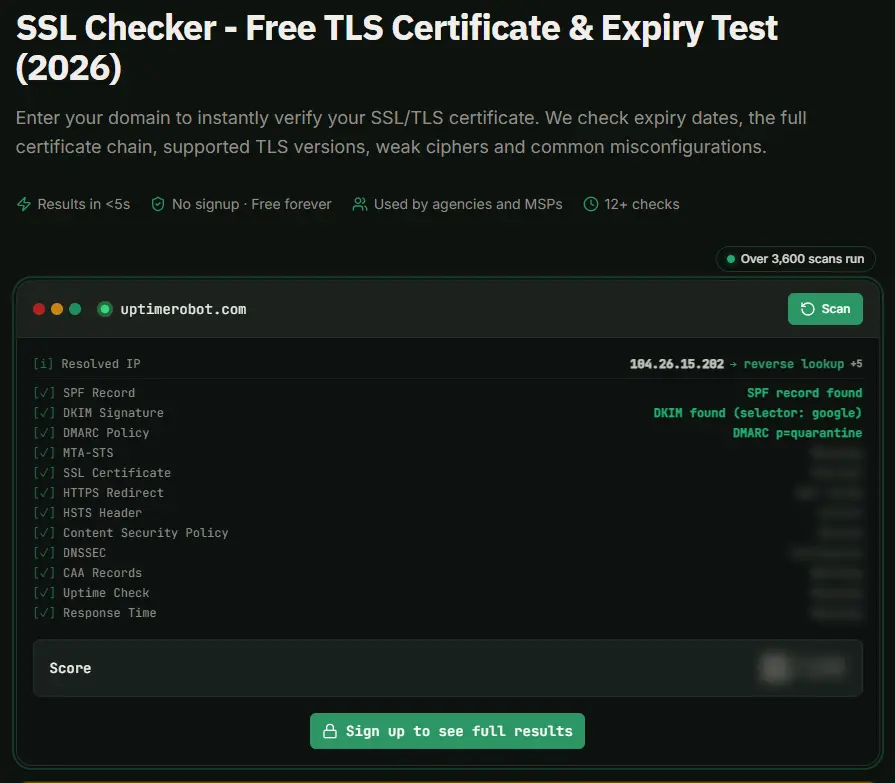
Domain Scan Tools widens the lens on the same problem. Its SSL checker evaluates certificate expiry, the full chain, and TLS versions and weak protocols, then checks cipher suites, SAN and hostname matching, and self-signed or untrusted issuers. That feeds into a dashboard that also covers DNS and email authentication, plus uptime, status pages, and reporting.
Agencies and SMBs often choose it because it brings DNS, email, and certificate monitoring together under one roof.
Pricing and scan frequency aren’t as clearly documented here as with more established vendors, and there’s no sign of full private-PKI discovery, ACME deployment orchestration, or a mature enterprise connector catalogue.
| Pros | Cons |
| Certificate, DNS, email authentication, and uptime monitoring in one dashboard | Pricing and scan frequency are less transparent than with more established vendors |
| Useful for agencies managing multiple client domains | Limited public information about private PKI or certificate lifecycle management (CLM) capabilities |
3. Qualys SSL Labs
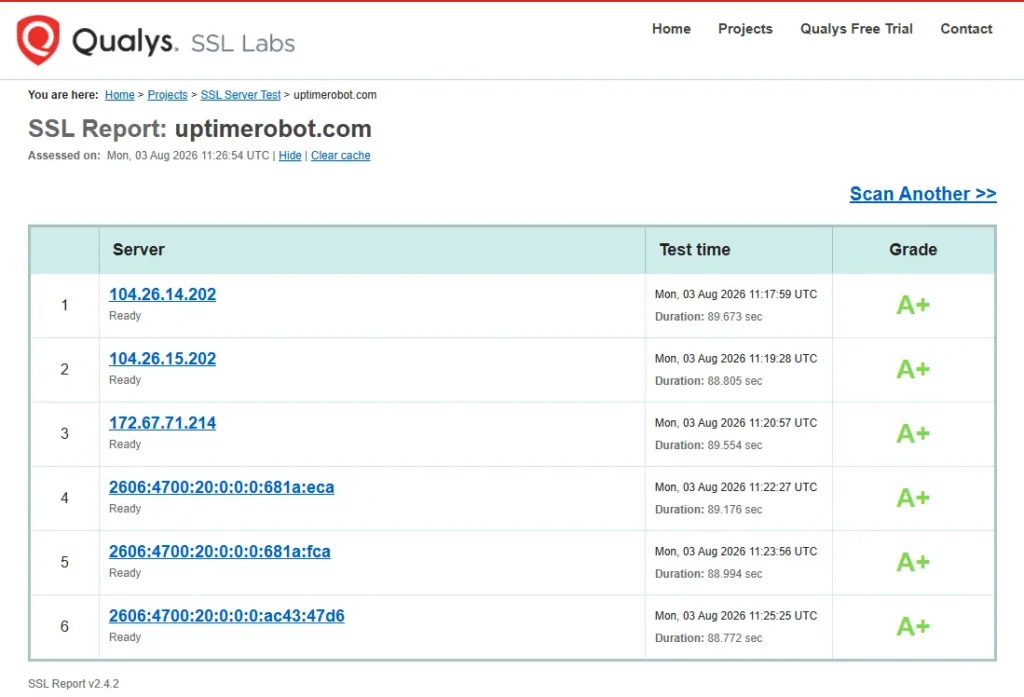
Qualys SSL Labs scan results
Qualys SSL Labs is the free diagnostic benchmark of this category. Its A through F grading and detailed protocol, cipher, and chain analysis remain the reference point security engineers reach for before or after a configuration change.
It’s free and credible, but the public API is assessment-oriented more than it is a monitoring product. New assessments are subject to concurrency and rate limits, and clients that submit too many at once get a 429 response.
There’s no continuous alerting, no inventory, and no renewal workflow here. SSL Labs answers “how is this certificate configured right now,” not “tell me before it breaks.”
| Pros | Cons |
| Free, trusted reference for SSL/TLS protocol and cipher analysis | No continuous monitoring or alerts |
| Detailed certificate, protocol, and cipher grading | No certificate inventory or lifecycle management |
| Widely recognized and credible assessment methodology | Rate limited for repeated automated testing |
4. Hardenize
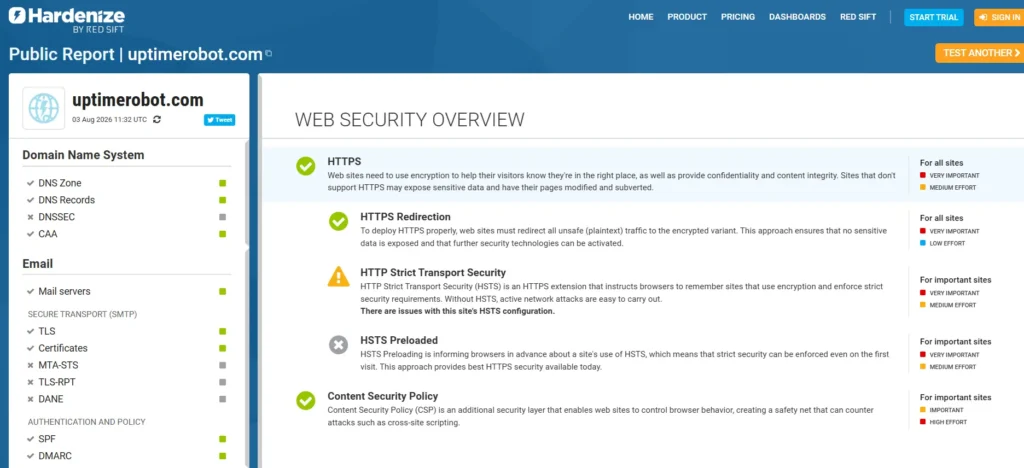
Hardenize SSL public report
Hardenize goes furthest on holistic posture, pairing asset discovery, certificate inventory, and expiry monitoring with network and security configuration analysis. It can also monitor third-party certificates a site depends on, ingest certificates discovered through Certificate Transparency, flag misissuance, expose a REST API, and check from 10 worldwide locations.
This depth suits security-conscious web estates and consultancies more than a simple single-site check.
Its Business plan covers 250 monitored hosts and Enterprise covers 500 or more, both gated behind a demo request, meaning no transparent self-serve pricing.
It isn’t built as a mass certificate-issuance or renewal engine, either. If full asset discovery isn’t the goal and dependable, transparently priced expiry and uptime alerts are, other platforms may be a better fit.
| Pros | Cons |
| Broad asset discovery across internal and external certificates | Pricing requires contacting sales for a demo |
| Monitors third-party certificates, not just internally managed ones | Not designed for certificate issuance or automated renewal |
| Certificate Transparency log ingestion helps identify unexpected certificates | Checks run from 10 global locations, not continuous validation |
5. SSLMate Cert Spotter
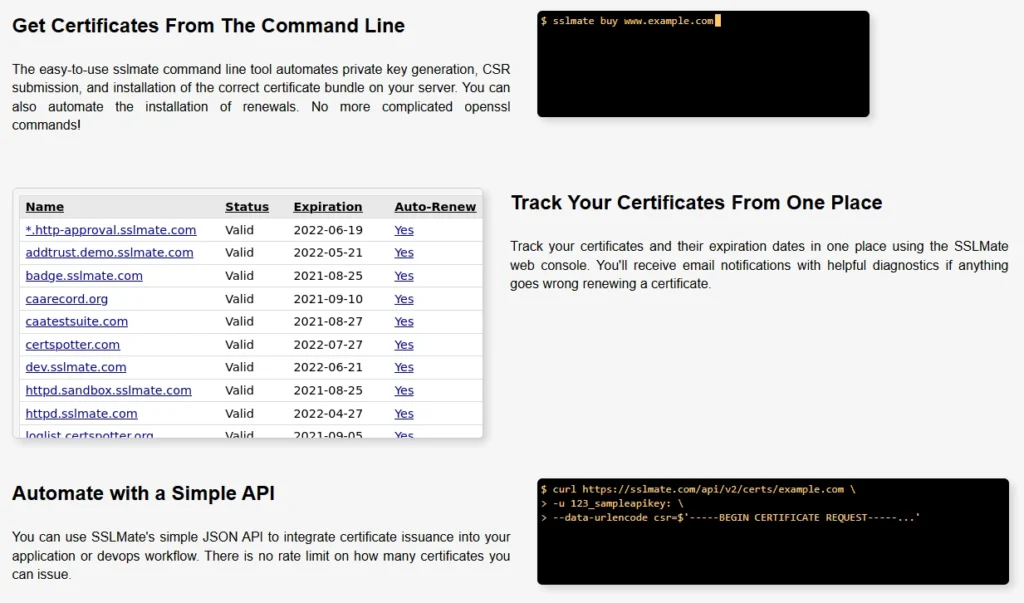
Source: Cert Spotter benefits
For Certificate Transparency specifically, Cert Spotter is the sharpest tool here. Its hosted service automatically discovers certificates and subdomains, then alerts on unauthorized or untrustworthy issuance the moment it appears in a public log.
It also monitors expiry and installation, and checks chain, hostname, and OCSP-stapling conditions, along with CAA and MTA-STS monitoring. Alerts go out over email, webhook, and Slack.
Pricing is quite transparent for this category: Hobbyist runs $15/month for up to 20 monitored domains with hourly checks, scaling to $100/month for 150 domains at 15-minute checks, and $500/month for 1,000 domains at five-minute checks across 10 locations.
Certificate Transparency logs can’t see certificates issued for internal, non-public hostnames, so Cert Spotter’s visibility stops at your public estate. The open-source edition, meanwhile, leaves notification, storage, and operations to you to build.
| Pros | Cons |
| Dedicated Certificate Transparency monitoring | Cannot monitor internal-only hostnames |
| Transparent, tiered pricing | Open-source edition requires you to build your own notification pipeline |
| Includes certificate chain and OCSP stapling checks | Limited to externally visible certificates |
6. Datadog Synthetic Monitoring
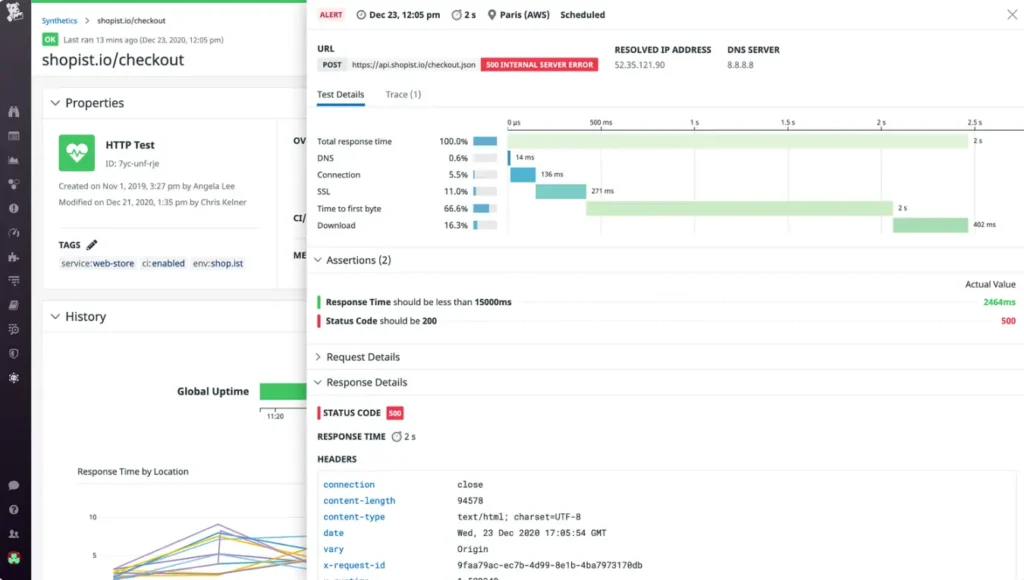
Source: Datadog’s SSL monitoring example
Datadog’s SSL tests make the most sense once a team is already standardized on its observability platform. The tests check certificate validity and expiration for public or internal hosts, run from managed or private locations on a schedule or on demand, and slot into CI/CD pipelines.
The payoff is correlation. An SSL incident shows up alongside logs, traces, and existing alerts in the same place you already work.
SSL monitoring here is one metered capability inside a broader Synthetics and observability bill, not a dedicated certificate inventory, and pricing depends on the surrounding plan rather than a flat rate.
| Pros | Cons |
| Correlates SSL incidents with existing logs and traces | SSL monitoring is priced as part of Datadog Synthetics, isn’t a standalone product |
| Supports checks from managed or private locations | Not designed as a dedicated certificate inventory tool |
| Can be integrated into CI/CD pipelines to catch certificate issues before deployment | Overkill if you only need SSL certificate monitoring |
7. Sematext Synthetics
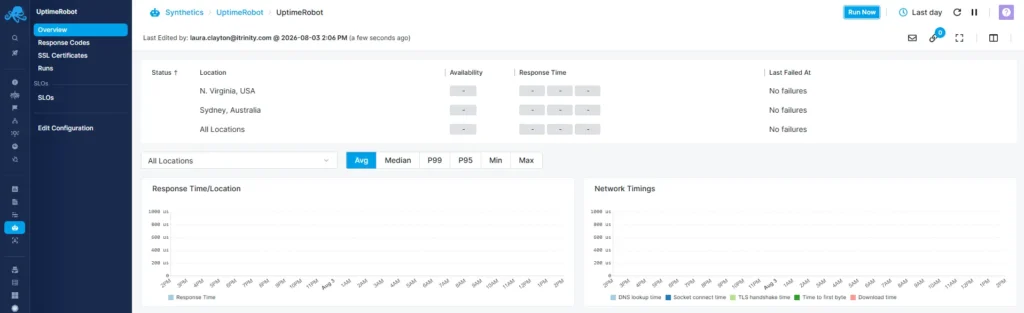
Sematext dashboard
Sematext suits developers and SREs who want certificate checks paired with performance data. It’s worth weighing against other synthetic monitoring tools too. It validates the leaf, intermediate, and root chain on every run and checks expiry daily, with alerts at 28, 14, seven, and three days out.
On HTTP monitors, it also detects certificate changes every 10 minutes and produces a change report. That’s backed by a large integration catalogue, so certificate alerts land wherever the rest of your monitoring already lives.
Pricing runs pay-as-you-go at $2 per HTTP monitor or $7 per browser monitor with a $5 monthly minimum, which can add up quickly for teams relying heavily on browser-based checks. It isn’t built as a CT-centric or certificate lifecycle management platform, either.
| Pros | Cons |
| Performs full certificate chain validation on every check | Browser-monitor pricing can become expensive at scale |
| Detects certificate changes quickly | No dedicated Certificate Transparency monitoring |
| Broad integration catalog for alerts and workflows | Lacks certificate lifecycle management capabilities |
8. Site24x7
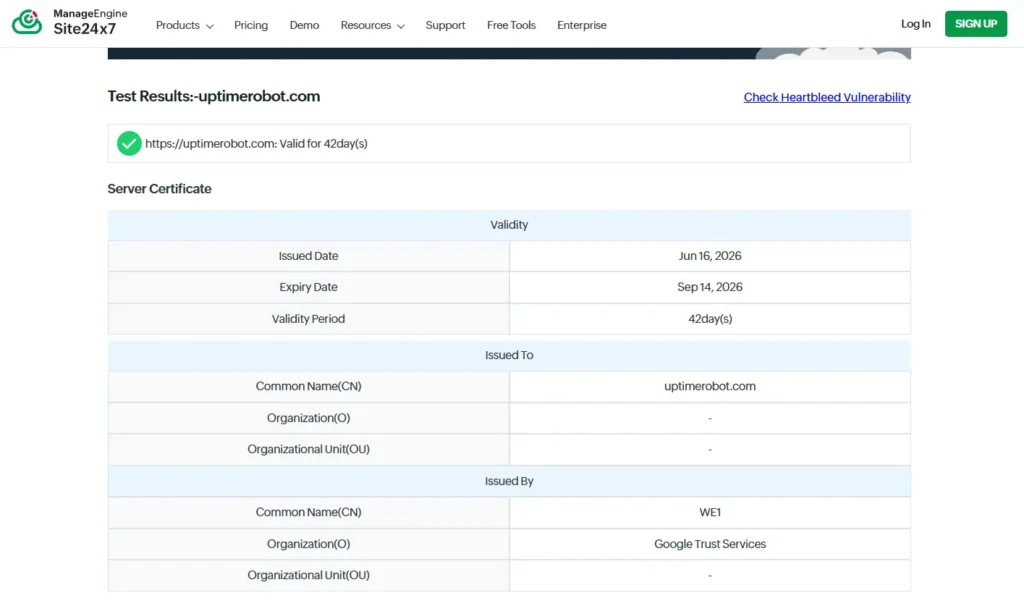
Site 24×7’s SSL Checker
Site24x7 folds certificate monitoring into a wider IT suite, which suits SMBs and MSPs that don’t want a standalone tool. It checks expiry and validity, revocation and SHA-1 fingerprint status, and blacklist-related signals.
An AWS Certificate Manager integration exposes certificate age, renewal eligibility, and status straight from ACM, using a read-only AWS policy so there’s nothing extra to provision beyond granting access.
A dedicated Terraform provider covers SSL certificate monitors alongside the rest of Site24x7’s resource types, so teams already managing infrastructure as code can define expiry checks the same way they define everything else.
Like some other platforms on this list, SSL monitoring isn’t a standalone product here. It’s one monitor type inside a much larger IT operations suite, so pricing and setup complexity scale with everything else you turn on, not just the certificates you’re watching.
| Pros | Cons |
| Certificate monitoring is included as part of a broader IT operations platform | No standalone SSL certificate monitoring pricing |
| Native integration with AWS Certificate Manager | More complex than dedicated SSL monitoring tools |
| Supports Terraform for infrastructure-as-code workflows | Includes many features beyond certificate monitoring that some teams may not need |
9. ManageEngine Key Manager Plus
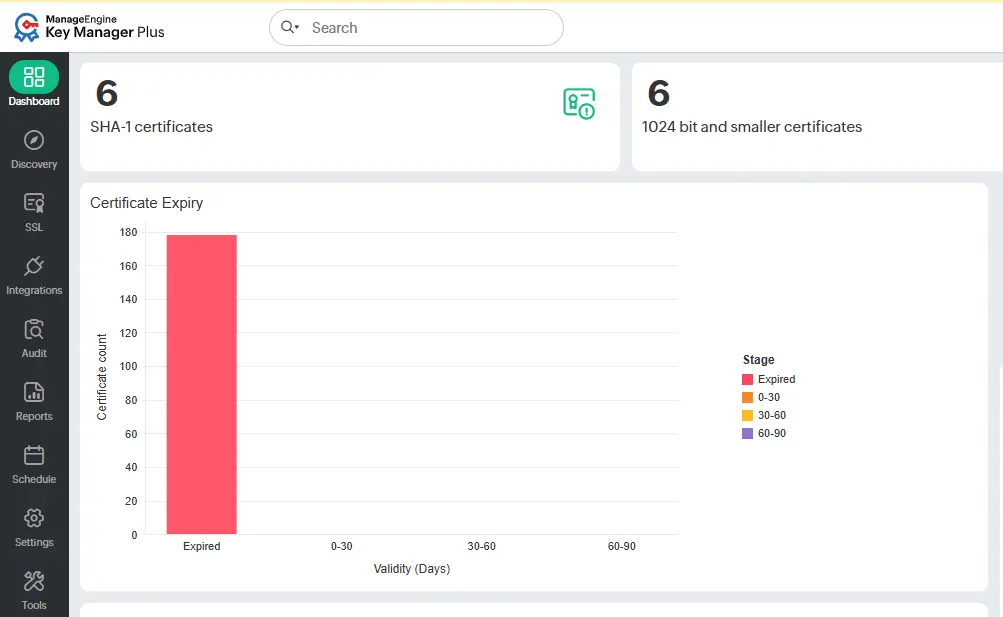
Key Manager dashboard
Key Manager Plus takes SSL monitoring several steps further into full lifecycle territory, including discovery, private CA issuance, deployment, and renewal; not just alerts.
It discovers certificates across web servers, load balancers, mail servers, AWS Certificate Manager, and the Microsoft Certificate Store, then centralizes them for tracking and renewal.
Built-in private CA capabilities sit alongside integrations with public CAs like Let’s Encrypt and DigiCert, so the same console can issue and track both internal and public-facing certificates.
Pricing starts at $475 a year for the Standard edition, scaled by the number of keys and devices managed. A free edition caps out at five managed keys or certificates, forever, which is enough to try it but not to run a real estate on.
Setup and ongoing administration take more effort than a lightweight checker, and the tool is built around internal certificate governance instead of continuously verifying what’s actually being served on a live public endpoint.
| Pros | Cons |
| Built-in private CA with integrations for public CAs | Administrative overhead increases as certificate estates grow |
| Discovers certificates across web servers, load balancers, cloud environments, and Microsoft certificate stores | Not designed to verify live endpoint behavior like continuous external monitoring |
| Transparent starting price | Better suited to certificate lifecycle management than external availability monitoring |
10. DigiCert CertCentral / DigiCert ONE
Source: DigiCert homepage
DigiCert CertCentral and its newer DigiCert ONE platform anchor certificate management to the certificate authority itself, appealing most to organizations already standardized on DigiCert as their CA.
CertCentral centralizes issuance, renewal, reissuance, and revocation, with automated discovery, vulnerability scanning, and role-based access controls for delegating work across teams.
DigiCert ONE folds that into a broader platform. Its Trust Lifecycle Manager module adds multi-CA visibility across DigiCert, Microsoft ADCS, AWS Private CA, Let’s Encrypt, and others, plus ACME, SCEP, EST, and CMPv2 automation and integrations with ServiceNow, JIRA, and CMDBs.
Governance built around a single CA relationship is exactly what some organizations want and exactly what others are trying to avoid, and pricing reflects an enterprise sales process.
If you only need to verify that a public endpoint is currently serving a valid certificate, it’s more than you need.
| Pros | Cons |
| Certificate issuance, governance, and management in a single console | Pricing and onboarding require an enterprise sales process |
| DigiCert ONE provides multi-CA visibility and supports automation protocols including ACME, SCEP, EST, and CMPv2 | Not designed for lightweight external endpoint monitoring |
| Integrates with ServiceNow and Jira for enterprise workflows | Better suited to certificate lifecycle management than simple SSL monitoring |
11. CyberArk Certificate Manager
Source: CyberArk homepage
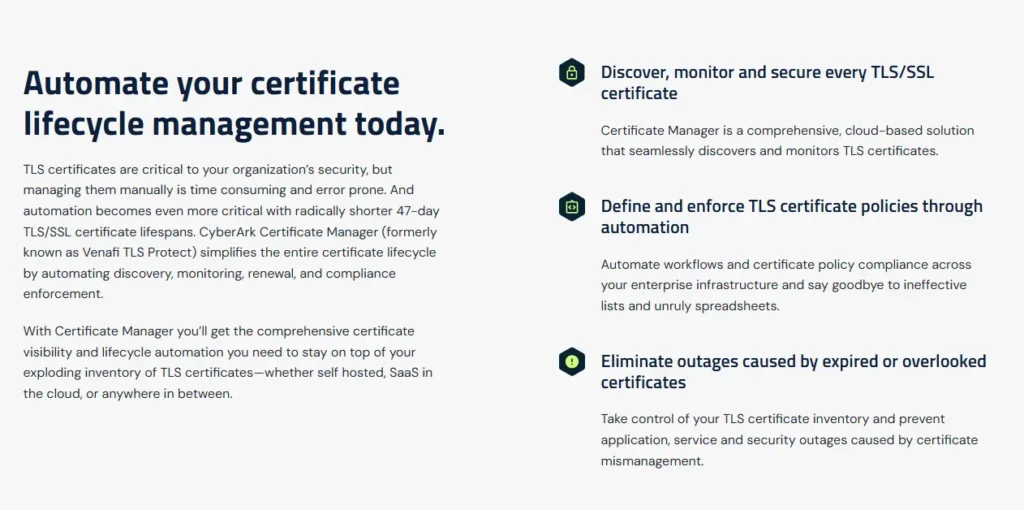
CyberArk Certificate Manager, built from the Venafi TLS Protect product line, is squarely aimed at the 47-day shift itself rather than treating it as one more line item.
It scans environments to discover certificates, monitors expiration continuously, alerts on upcoming renewals, and automates renewal to remove the manual step that breaks down once teams are touching certificates eight or more times a year.
CyberArk frames the shift bluntly: an 8 to 12x increase in renewal volume as validity drops from 398 days toward 47, which is precisely the workload manual processes can’t absorb.
Pricing is quote-based and follows an enterprise procurement cycle, not a self-serve signup.
This is built for large, complex machine-identity estates, and the depth that serves a global enterprise is more than most teams need for a handful of public-facing domains.
| Pros | Cons |
| Built for the 47-day SSL certificate lifecycle | Pricing and onboarding require an enterprise sales process |
| Automates certificate discovery, issuance, renewal, and governance at scale | More capabilities than most small teams or single-domain sites need |
| Well suited to large machine identity environments | Better suited to enterprise certificate lifecycle management than basic SSL monitoring |
12. Keyfactor Command
Source: SSL/TLS Discovery demo
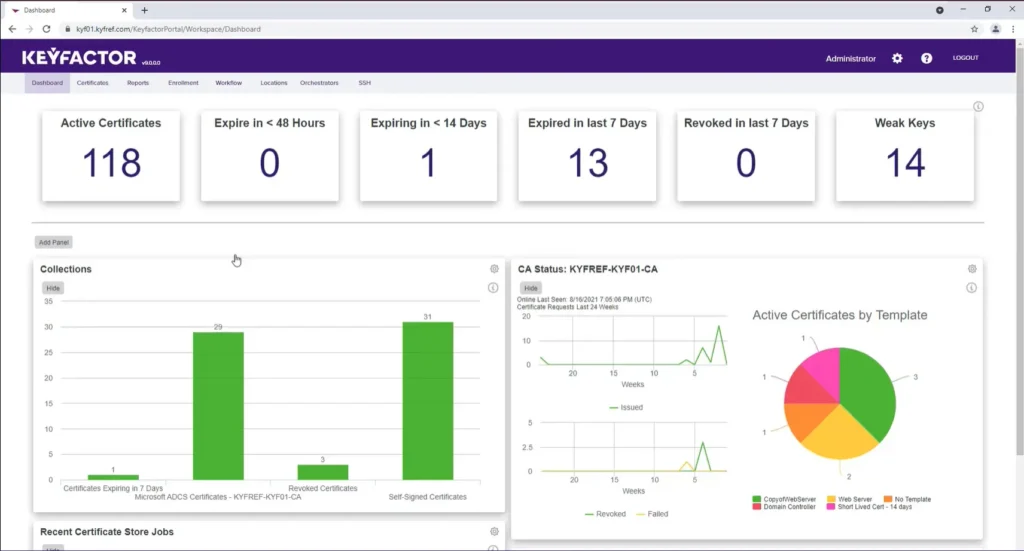
Keyfactor Command brings the deepest automation layer here, built for teams running multi-CA, HSM-backed, or Kubernetes-native infrastructure. It’s built on a modular, API-first architecture with direct integrations into DevOps tooling, key vaults, and mobile and IoT device management, plus a self-service portal and more than 50 pre-built third-party integrations.
A container-based Kubernetes deployment, installable via Helm, gives teams real-time visibility across public and private CAs, cloud services, and Kubernetes clusters without requiring Windows Server or Active Directory.
That connector catalogue and infrastructure flexibility come with real setup investment, and pricing is quote-based, reflecting the enterprise deployments it’s built for.
| Pros | Cons |
| API-first architecture with more than 50 integrations | Pricing requires an enterprise quote |
| Native Kubernetes support through Helm | Enterprise-scale deployment is more complex than most teams need |
| Real-time visibility across public and private CAs | Overkill if you only need certificate expiry and endpoint alerts |
Next steps
If you’re monitoring public websites or APIs, UptimeRobot gives you SSL certificate monitoring alongside uptime checks in a single dashboard. Certificate expiry reminders, SSL error detection, and uptime alerts work together, so you’ll know immediately if a certificate expires, becomes invalid, or causes your service to go down.
-
Choose a tool that alerts you before certificates expire and detects problems such as invalid, misconfigured, or incomplete certificate chains. If you manage public domains, Certificate Transparency monitoring is also valuable. Finally, look for alerting channels and pricing that match your team’s needs.
-
Continuous monitoring is the safest approach. Most tools check certificates every few minutes to once a day and send multiple expiry reminders before renewal is due. As certificate lifetimes continue to shrink, manual tracking is becoming increasingly impractical.
-
SSL monitoring checks live certificates and alerts you to expiry or validation problems. TLS posture testing evaluates protocols, cipher suites, and configuration to identify security weaknesses. Many organizations use both because they solve different problems.
-
Yes. Tools like Qualys SSL Labs offer free options for basic SSL monitoring or TLS testing. Larger environments that need Certificate Transparency monitoring or certificate lifecycle management typically require paid plans.
-
Certificate Transparency monitoring detects certificates issued for your public domains, including ones your team didn’t request. That helps identify unauthorized or mistaken certificate issuance that internal inventories won’t catch.
-
For many websites and APIs, one monitoring tool is enough. Organizations that also need TLS testing, Certificate Transparency monitoring, or certificate lifecycle management often combine multiple tools because each serves a different purpose.
-
An expired certificate can trigger browser warnings, failed integrations, or service disruptions. Continuous monitoring and automated renewal help catch problems before they affect users.