Did you have trouble paying for your coffee with your Revolut card on Tuesday morning? It wasn’t just you.
On October 20, 2026, Revolut’s app and cards stopped working for customers across Europe. Card payments and card top-ups failed, and by 10:08 UTC Revolut’s UK status page listed 30 services as partially unavailable.
The problem started one layer below Revolut.
Google Cloud’s London region, europe-west2, had been failing since 06:08 UTC, and Google later traced it to a power event in one of its London zones. Revolut hasn’t named a cause publicly, but a person familiar with the matter told Reuters that the outage was related to the Google Cloud disruption.
Revolut wasn’t the only one having a bad morning. UK media also reported problems at banks like Lloyds and HSBC. We can’t confirm those were connected to Google Cloud, but the timing makes it hard to call a coincidence.
What happened at Google Cloud (the short version)
According to Google’s status page, the incident began at 06:08 UTC, when services in europe-west2 started returning errors and failing to connect.
By midday, 38 Google Cloud products were on the affected list, including Compute Engine, Kubernetes Engine, Cloud SQL, Cloud Storage and BigQuery.
The cause came at 11:12 UTC:
Due to a power event we had suffered an outage within europe-west2-b zone.
By then the power problem was fixed, and Google was bringing existing workloads back first. By 12:10 UTC, most of them had recovered, and at 14:00 UTC Google marked the issue as mitigated for most customers, almost eight hours after it started.
A small number of customers were still affected, and Google said it would publish an analysis once its internal investigation is done.
The power event hit one zone, but Google said services across the wider London region could also see errors. Its suggested workaround was to move affected workloads to another zone or region “if feasible.”
For a team whose stack lives in one region, that’s a project, and a hard one to start in the middle of an outage.
The timeline
| Time (UTC) | What happened |
| 06:08 | The outage starts in europe-west2, per Google’s status page |
| 06:00 to 06:20 | User reports about Revolut start climbing on IsDown |
| 06:30 | IsDown flags a widespread Revolut outage from user reports |
| 07:00 to 07:20 | Revolut user reports peak |
| 07:47 | Revolut’s status page marks card payments and card top-ups as affected |
| 07:54 | Revolut posts on X about a service disruption and says customers’ money and data are safe |
| 08:35 | Google shares its first update, saying it is investigating, with no workaround |
| 08:35 | Our Is Google Cloud down? page switches to Down |
| 09:24 | Google suggests moving workloads to another zone or region |
| 10:08 | Revolut’s UK status page shows 30 services partially unavailable |
| 11:12 | Google names the cause, a power event in europe-west2-b |
| 12:10 | Google sees recovery for most workloads in europe-west2 |
| 14:00 | Google marks the issue as mitigated for most customers |
Who said what, and when
Google shared its first update at 08:35 UTC, almost two and a half hours after the outage started. It said the team was investigating, and that there was no workaround “for now.” The actual cause followed at 11:12, about five hours in. In fairness to Google, each update said when the next one would come, and they arrived on time.
Revolut spoke up sooner.
Its status page flagged card payments at 07:47, and it posted on X at 07:54, 41 minutes before Google’s first update. The post said customers’ money and data were safe and that the team was working on a fix.
After that, though, it stayed Revolut’s only update on X for hours.
For a business that runs on Revolut, those quiet hours are the hard part. A café that can’t take card payments needs to know whether to wait ten minutes or put up a “cash only” sign for the day.
Even a short update with what’s broken, what still works and when to expect the next one helps people make that call.
What we saw from UptimeRobot
Revolut’s customers noticed first. On IsDown, which UptimeRobot acquired in 2026, user reports about Revolut started climbing shortly after 06:00 UTC and peaked between 07:00 and 07:20.
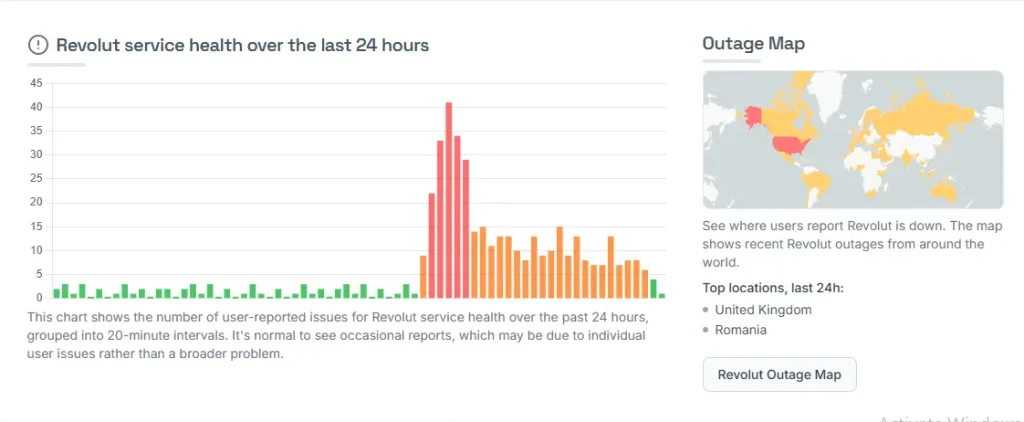
IsDown flagged a widespread Revolut outage from those reports at 06:30 UTC, 77 minutes before Revolut’s own status page and more than two hours before Google’s first update.
By 14:00 UTC, IsDown had received 333 user reports about Revolut, most of them from the UK. People wrote that they couldn’t log in, send money, pay by card or move money between their own accounts.
Google Cloud itself got only a handful of user reports all day. That makes sense, since people don’t see the cloud provider, only the app that stopped working.
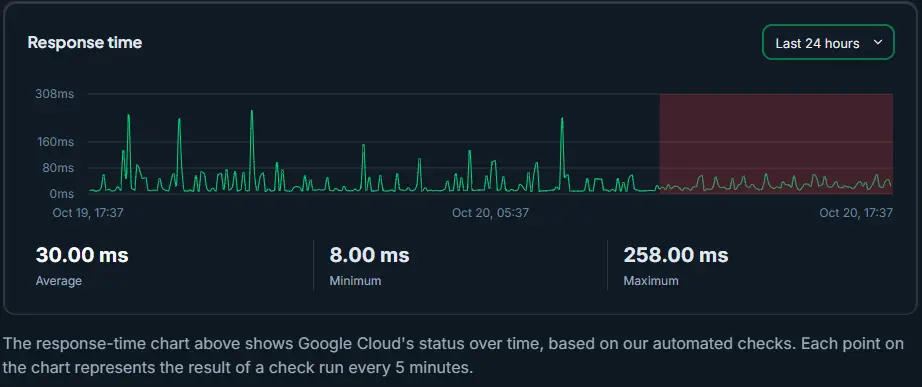
Our Is Google Cloud down? page follows Google’s official status page, so it switched to Down at 08:35 UTC, together with Google’s first update.
Getting ready for the next one
A power problem in one London zone was enough to stop card payments for people across Europe. Most of the businesses affected couldn’t have prevented it, and they couldn’t fix it either. What they could control was how quickly they found out, and what they told their own customers while they waited.
Outages like this one will happen again, and most teams find out about them the same way: from customers, or from a post on X. The easiest fix is to have your providers’ incidents come to you.
That’s what UptimeRobot’s Third party monitoring does.
You pick the services your product runs on, Google Cloud among more than 6,000 others, and choose the parts you actually use.
When their status changes, you get an alert through the same email, Slack or other channels you already use for your own monitors, so you’re not refreshing a status page while your customers wait.
Get 50 monitors with 5-minute checks, free, no credit card required.