This is a documentation-based comparison using publicly available product information and pricing. Inclusion is for comparison, not an endorsement; feature availability and prices can change, so verify important details with each provider.
Your domain can expire, DNS records can change unexpectedly, or someone can register a lookalike domain to impersonate your business. Each problem requires a different type of monitoring.
Some tools help you keep your website online and your domain healthy. Others detect phishing and brand impersonation, while domain marketplaces help you find names to buy.
UptimeRobot’s analysis of its monitored websites found that the typical monitored website recorded 2-4 hours of downtime over a 12-month period. Around 3-4 in 10 recorded more downtime than the 8 hours and 45 minutes allowed by 99.9% uptime. These findings show why monitoring matters, though they represent UptimeRobot-monitored websites rather than the internet as a whole.
Here’s how 14 domain monitoring tools compare, what each does best, and which one makes sense for your needs.
Which domain monitoring do you need?
Choose a tool based on the problem you need to catch or solve:
- Domains you own: Look for renewal and expiry reminders, DNS-change alerts, SSL certificate monitoring and website uptime checks. UptimeRobot covers core uptime on Free, while its domain-expiry, SSL and DNS monitoring start on Solo. Domainyze is another option for a multi-domain portfolio.
- Lookalike domains and phishing: Choose a tool that discovers suspicious domains and supports investigation or takedowns. Consider Netcraft, ZeroFox, BrandShield or Valimail for relevant use cases; use dnstwist for open-source lookalike discovery.
- Domains you want to buy: Use ExpiredDomains.net to discover expired or pending-delete names, then consider DropCatch or NameJet for backorders and auctions. A listing or backorder is not a guarantee that you’ll acquire a domain.
A 15-minute domain monitoring checklist
Use this quick pass to cover the most immediate risks. It won’t replace a full security review, but it can expose obvious gaps.
- Minutes 0-3: Inventory your domains. List your primary domain, important subdomains and customer-facing services. Note each registrar, renewal date and DNS provider.
- Minutes 3-6: Check account protection. Confirm auto-renewal and payment details, review recovery contacts, enable multifactor authentication and turn on registrar or transfer locks where available.
- Minutes 6-9: Set availability and expiry alerts. Monitor critical sites and APIs. Add domain-expiry reminders; if using UptimeRobot for expiry monitoring, you need Solo or a higher paid plan. SSL monitoring is also paid, starting on Solo.
- Minutes 9-12: Review DNS and certificates. Record the expected values for important DNS records and check certificate expiry. UptimeRobot DNS monitoring starts on Solo; make sure alerts go to someone who can act on them.
- Minutes 12-15: Check for impersonation. Search for plausible lookalike domains with a tool such as dnstwist or a brand-protection service. Treat matches as leads to investigate, and identify who will handle a confirmed phishing report or takedown request.
Best domain monitoring software at a glance
- Best overall for monitoring domains you own: UptimeRobot combines website uptime monitoring with domain-health alerts; domain-expiry, SSL and DNS monitoring start on Solo.
- Best for monitoring a domain portfolio: Domainyze tracks domain status, expiry, DNS and SSL across multiple domains.
- Best for phishing detection and takedowns: Netcraft identifies phishing and deceptive domains and helps disrupt confirmed threats.
- Best free website monitoring: UptimeRobot offers 50 monitors and five-minute checks on its Free plan.
- Best for website and SSL monitoring: StatusCake combines uptime checks with SSL and domain monitoring.
- Best for certificate transparency monitoring: Cert Spotter alerts you to certificates recorded for your domains.
- Best for email authentication: Valimail helps organizations monitor email authentication and investigate impersonation risks.
- Best for broad digital brand protection: ZeroFox covers online threats across domains, social media and other digital channels.
- Best for counterfeit and brand enforcement: BrandShield focuses on online brand misuse and counterfeit activity.
- Best paid all-in-one for website and domain health: UptimeRobot Solo combines one-minute uptime checks with domain-expiry, SSL and DNS monitoring.
- Best for combining uptime and domain-health monitoring: UptimeRobot brings availability checks together with domain-expiry, SSL and DNS monitoring features.
- Best for domain intelligence: DomainTools helps security teams investigate suspicious domains.
- Best free, open-source lookalike discovery: dnstwist generates potential lookalike domains for investigation.
- Best for finding expired domains: ExpiredDomains.net helps users search expired and pending-delete listings.
- Best for acquiring dropping domains: DropCatch and NameJet help buyers pursue domains through backorders and auctions.
Domain monitoring software comparison
| Tool | Best for | What it monitors | Starting price |
|---|---|---|---|
| UptimeRobot | Domain and website health | Uptime; domain expiry, SSL and DNS | Free; Solo from $12/month billed annually ($144/year) |
| Domainyze | Domain portfolios | Expiry, DNS, SSL and domain lifecycle | Free; Pro at $199/year billed annually |
| StatusCake | Website and SSL monitoring | Uptime, domain and SSL status | Free; Superior from $20.41/month billed annually |
| Site24x7 | IT monitoring | Domain expiry, SSL and infrastructure | From $9/month for website monitoring, billed annually |
| Cert Spotter | Certificate monitoring | Certificate transparency and certificate health | $15/month |
| Netcraft | Phishing protection | Malicious domains and phishing sites | Custom quote |
| Valimail | Email authentication | DMARC and email-sending activity | Depends on product |
| ZeroFox | Digital brand protection | Domains, social media and online threats | Custom quote |
| BrandShield | Brand enforcement | Impersonation and counterfeit activity | Custom quote |
| DomainTools | Security investigations | Domain intelligence and related infrastructure | Depends on product |
| dnstwist | Lookalike discovery | Potentially deceptive domain variations | Free |
| ExpiredDomains.net | Expired-domain discovery | Expired and pending-delete listings | Free |
| DropCatch | Domain acquisition | Domains approaching release | Depends on domain |
| NameJet | Domain auctions | Expired-domain listings and backorders | Depends on listing |
Prices and plan limits can change, so check each provider’s current pricing and feature documentation before choosing. For UptimeRobot, Free covers core uptime monitoring; domain-expiry, SSL and DNS monitoring start on the paid Solo plan. See the [pricing page](https://uptimerobot.com/pricing/) and the feature-specific Help Center pages for the latest eligibility details.
Best tools for monitoring domains you own
If you’re protecting domains you already control, prioritize renewal reminders, DNS-change alerts, SSL certificate checks and website availability monitoring. These checks cover different failure modes: a site can respond while a renewal deadline is approaching, or its DNS and certificate can have problems even when the domain registration is valid.
1. UptimeRobot
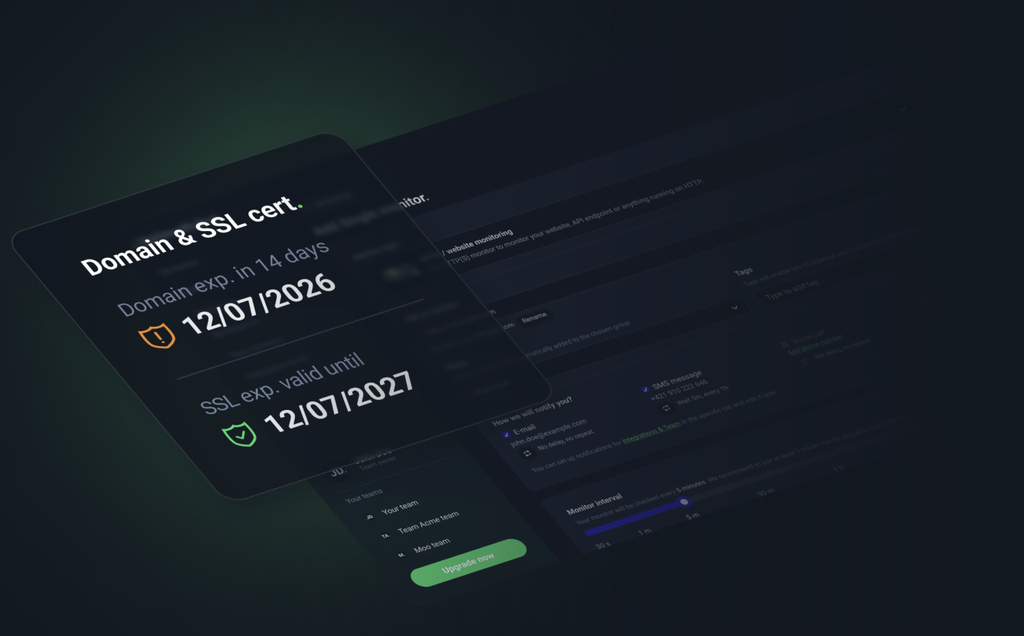
UptimeRobot combines uptime monitoring with domain-health alerts. You can monitor whether a website responds as expected, then add alerts for domain expiration monitoring, SSL certificate problems and DNS changes.
UptimeRobot’s Free plan includes 50 monitors, five-minute uptime checks and basic status pages, and it can be used commercially without a credit card. Domain-expiry, SSL and DNS monitoring start on Solo, not Free. Solo also shortens the monitoring interval to 60 seconds; check the current pricing page for the latest price and limits.
We did an analysis of our internal monitoring data and they also highlight why timely detection matters. Among websites checked every minute, recorded outages lasting more than an hour accounted for at least 85% of downtime. The finding illustrates the importance of detecting persistent problems, although recorded check failures don’t always mean a website was unavailable to visitors.
Best for: Website owners, developers, freelancers and IT teams that want availability monitoring on Free and domain-health checks when they upgrade to Solo or higher.
Keep in mind: UptimeRobot’s domain-expiry, SSL and DNS checks require Solo or a higher paid plan. Uptime monitoring alone doesn’t prevent domain hijacking or detect every lookalike domain.
2. Domainyze
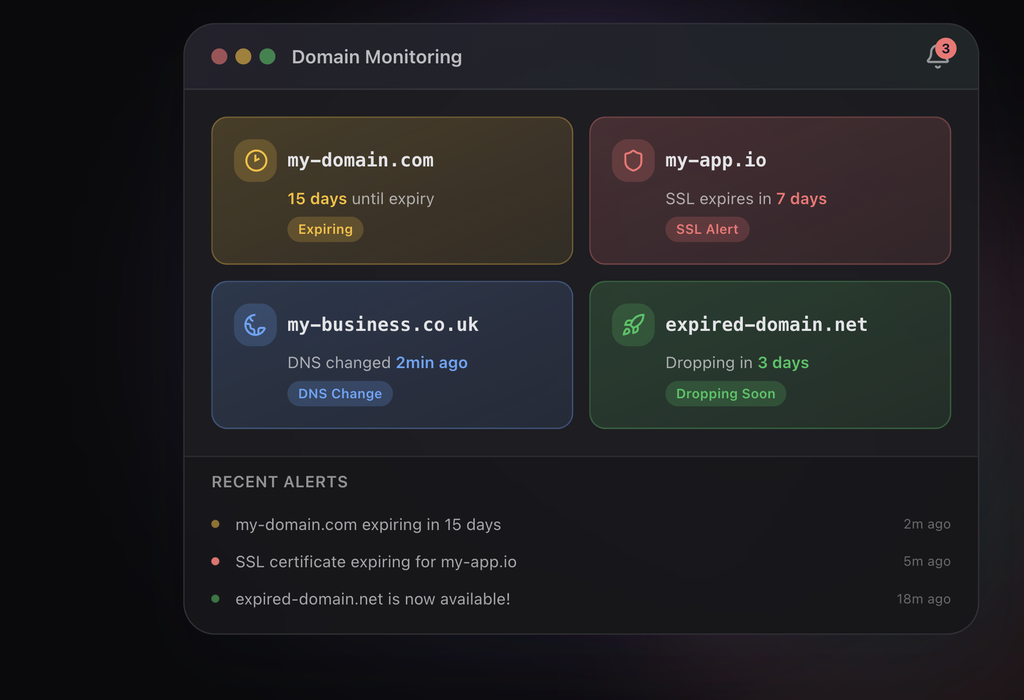
Domainyze watches the domains you own and the ones you want to buy from one dashboard. For your own portfolio it tracks expiry dates read from the registry, registrar and status changes, DNS record changes, SSL certificate expiry and chain problems, and SPF, DKIM and DMARC records.
On the buying side, you can add names to a watchlist and get lifecycle alerts as a domain moves through grace, redemption and pending delete. Domainyze forecasts the drop date and checks much more often once a name enters its drop window.
- The Free plan covers 5 domains with checks every 12 hours and email alerts.
- Pro covers 200 domains and Business 500, with checks every 6 hours at rest and every 2 minutes (Pro) or every minute (Business) in the drop window.
- Paid plans add Slack, Discord and webhook alerts. A REST API and an MCP server are available too.
Best for: Agencies, businesses and domain investors who manage dozens or hundreds of domains and want expiry, DNS and SSL alerts in one place.
3. StatusCake
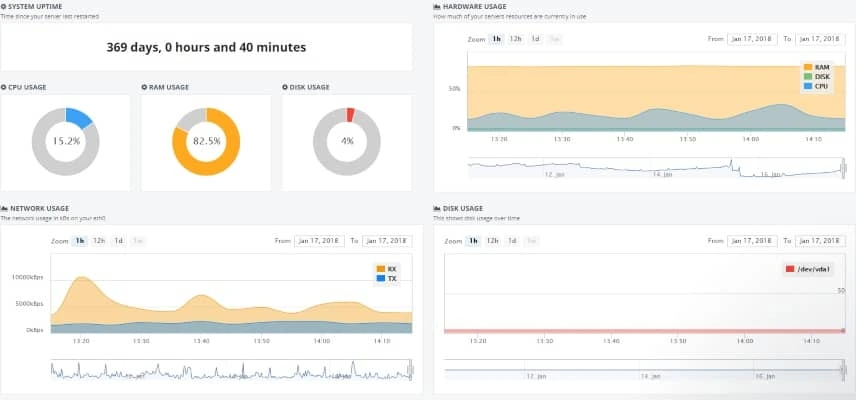
StatusCake is a website monitoring service with separate monitors for uptime, page speed, SSL certificates, domains and servers. Its domain monitors alert you before a domain expires and can also watch DNS records and blacklist status, so they suit teams that want domain checks next to their uptime checks.
SSL monitors warn you before a certificate expires and can flag mixed content on your pages and score your certificate setup.
- The Free plan includes 10 uptime monitors with 5-minute checks, 1 domain monitor and 1 SSL monitor.
- Superior raises that to 100 uptime monitors with 1-minute checks, 50 domain monitors and 50 SSL monitors. Business includes 120 domain monitors and 100 SSL monitors.
- Domain checks run every 7 days on Free and Superior and every 5 days on Business. SSL checks run every 24 hours on Free, every 30 minutes on Superior and every 10 minutes on Business.
- Paid plans come with a 7-day free trial, no credit card required.
Best for: Website operators who want uptime, SSL and domain expiry alerts from one provider.
4. Site24x7
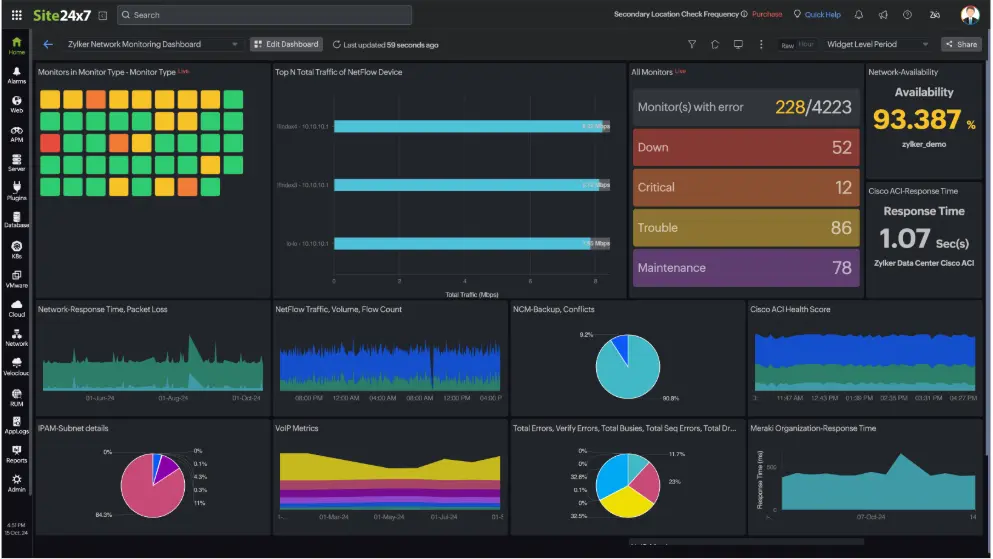
Site24x7 is a broad IT monitoring platform from Zoho that covers websites, servers, cloud services, networks and applications. Domain expiry monitoring is one monitor type inside it: it checks your domain’s registration and alerts you a set number of days before it expires.
The domain monitor shows the registration date, expiry date, last-modified date and the registrant details. It reports a Trouble status when your alert threshold is reached and goes Down when the domain has expired or the WHOIS server can’t be reached. You can schedule maintenance, export reports as PDF and show the monitor on a public status page.
- Domain expiry monitoring makes the most sense if your team already uses Site24x7 for infrastructure or application monitoring.
Best for: IT teams that want domain expiry alerts inside the same platform they use for servers, cloud and network monitoring.
5. Cert Spotter
Cert Spotter, from SSLMate, watches Certificate Transparency logs and alerts you when a certificate is issued for one of your domains that you didn’t expect. That can point to a compromised certificate authority account, DNS tampering or a subdomain takeover. You can tell it in advance which certificates and certificate authorities are legitimate, so you’re only alerted about the ones that need a look.
It also runs certificate health checks that catch installation problems such as a mismatched hostname or an incomplete chain, and gives you instructions to fix them, including the correct chain to install or how to revoke a certificate.
- Hobbyist costs $15 a month for up to 20 endpoints, with health checks every hour.
- Startup ($100 a month) covers 150 endpoints with checks every 15 minutes, discovers domains through DNS provider and registrar integrations, and can send alerts to a webhook. Business ($500 a month) covers 1,000 endpoints with checks every 5 minutes.
- Every plan has a 30-day free trial.
Best for: Security and ops teams that want to know about every certificate issued for their domains, and about certificate problems before visitors see a browser warning.
Best tools for phishing and lookalike domains
If you need to find domains that imitate your brand, prioritize lookalike discovery, phishing detection, investigation and takedown support. Basic uptime or expiry monitoring for domains you own generally won’t discover copycat registrations on its own.
Netcraft
Netcraft specializes in finding and taking down phishing sites, scams and fraudulent infrastructure that targets your brand and customers. It classifies more than 100 attack types and processes over 23 billion data points a year, using automation, machine learning and tens of thousands of hand-written detection rules.
Where other services stop at an alert, Netcraft handles the takedown. It reports a median takedown time of 33 minutes for phishing threats and says it takes down about a third of the world’s phishing attacks. It can also block threats in near real time while a takedown is in progress.
- Netcraft is sold as a managed service with custom pricing.
Best for: Banks, retailers and other frequently impersonated brands that need phishing sites found and removed quickly.
Valimail
Valimail is a DMARC platform. It shows which services send email using your domains, whether those messages pass SPF and DKIM, and how close each domain is to DMARC enforcement, the point where receiving mail servers reject messages that fake your domain.
Its free Monitor product gives you visibility across all your sending domains. Paid products such as Enforce automate SPF, DKIM and DMARC record management to get you to enforcement faster, and Valimail also supports BIMI, which displays your logo next to authenticated emails in supported inboxes.
- DMARC protects your exact domain from being spoofed in email. It doesn’t stop someone registering a lookalike domain, so pair it with a lookalike discovery tool if that’s your risk.
Best for: Businesses that want to stop attackers sending email as their domain and get to DMARC enforcement without managing DNS records by hand.
ZeroFox
ZeroFox is an external cybersecurity platform that maps and monitors your whole digital footprint: domains, subdomains, IP addresses, social media accounts, executive profiles, exposed credentials and misconfigurations. Its analysts also gather intelligence from threat channels and dark web sources.
Threats are validated by people before they reach you, which cuts down on false positives, and ZeroFox handles takedowns of fake domains, impersonating accounts and fraudulent pages across social platforms and marketplaces.
- Pricing is custom and depends on the services you choose.
Best for: Larger organizations that need domain, social media and executive impersonation monitoring with takedowns, all from one provider.
BrandShield
BrandShield combines AI-based detection with an enforcement team that removes threats for you. It looks for phishing sites, lookalike domains and copycat websites, fake social media accounts and impersonation profiles, and counterfeit listings or unauthorized sellers on ecommerce marketplaces.
Takedowns are handled by BrandShield’s enforcement managers, and its clustering can group related listings or sites so they can be removed together. It has dedicated programs for industries that are frequent targets, including pharma, finance, retail, gaming and travel.
- Pricing is custom.
Best for: Consumer brands dealing with counterfeit products, fake shops and repeated impersonation across domains, social media and marketplaces.
DomainTools
DomainTools collects DNS, WHOIS and certificate data at internet scale and turns it into threat intelligence. Security teams use it to spot risky domains as soon as they’re registered or start appearing in passive DNS, and to see whether new domains are spoofing their brand.
Its Iris investigation platform lets analysts pivot from one suspicious domain to connected infrastructure, such as other domains sharing a registrant, name server or IP address. DomainTools also offers real-time risk feeds for SIEM and SOC tools, and a connector for LLM assistants.
- Products are priced separately and mostly sold to security teams.
Best for: Security analysts and threat-intelligence teams investigating phishing campaigns and the infrastructure behind them.
dnstwist
dnstwist is a free, open-source command-line tool. You give it your domain, and it generates thousands of possible lookalike variations using different techniques, such as swapped characters, homoglyphs that look like your letters, added hyphens and different TLDs. It then checks which of those variations are actually registered and returns their DNS records.
It can go further than a simple list: it flags domains with mail servers that could intercept misdirected email, compares registered lookalike pages with your site using HTML and screenshot similarity, and accepts dictionaries of common phishing words. Results can be exported as CSV or JSON.
- You run it yourself, from Python or Docker, so it suits technical teams. It finds candidates; deciding which ones are a real threat and getting them taken down is up to you.
Best for: Developers and security teams that want a free way to check for typosquatting and lookalike domains, or to run scheduled scans of their own.
Best tools for expired and dropping domains
An expired domain doesn’t necessarily become available immediately. Depending on its extension and registry rules, it may pass through recovery or redemption and pending-delete stages before release. Some names also go through auctions.
ExpiredDomains.net
ExpiredDomains.net publishes daily updated lists of expired, deleted and pending-delete domains across more than 600 TLDs, from .com and .net to country-code and newer extensions. Its database holds hundreds of millions of domains, with well over a million added every day.
Each listing comes with SEO data such as backlinks, Majestic Citation Flow and Trust Flow, and the first Archive.org capture, so you can filter for names with history worth having. A watchlist lets you keep track of the domains you’re interested in.
- It’s a discovery tool: it shows you what’s dropping, and you buy or backorder the name through a registrar or a drop-catching service.
Best for: SEOs, domain investors and founders looking for an expired domain with existing backlinks or a good name.
DropCatch
DropCatch tries to register domains the moment they’re released after expiring. You place a backorder on the name you want, and DropCatch attempts to catch it when it drops. A backorder shows your interest but doesn’t guarantee you’ll get the domain, especially for names many buyers want.
Before you backorder, check the name’s history on archive.org and in a spam blacklist, look for trademark conflicts, and decide your maximum budget in case it goes to auction.
Best for: Buyers who want a specific expiring domain and are willing to compete for it.
NameJet
NameJet offers backorders on expiring domains and runs auctions for names that more than one buyer wants. Depending on the listing, you may be bidding against other buyers, so the final price can be well above the starting price.
As with any drop service, research the domain’s past use and set a firm maximum bid before an auction starts.
Best for: Buyers looking to pursue expired domains through backorders and auctions.
How we evaluated the tools
We reviewed publicly available product documentation, feature descriptions and pricing pages on October 23, 2026. This is a documentation-based comparison, not a controlled hands-on test of every product.
We considered monitoring coverage, check frequency, alert and response options, false-positive handling, pricing transparency and ease of setup.
These factors matter because a website uptime monitor, a phishing detection platform and a domain auction service solve different problems. The right choice depends on the information you need and what you want to do when something changes.
Real incidents: why domain monitoring matters
Marketo: an expired domain caused an outage
In July 2017, Marketo experienced a major outage after its marketo.com domain wasn’t renewed successfully. The incident disrupted its services and demonstrated how a registration problem can affect more than a website.
What monitoring could have helped with: An independent expiry alert could have provided another opportunity to catch the renewal problem before the outage.
Read the ThousandEyes incident analysis
Perl.com: domain hijacking
In January 2021, Perl.com was hijacked and its DNS began directing visitors to different IP addresses. The incident highlighted the importance of registrar account security and monitoring DNS changes.
What monitoring could have helped with: Alerts about unexpected DNS changes might have helped the team investigate sooner. Registrar security and access controls are still essential.
Read the Perl community’s incident report
How to choose the right domain monitoring tool
The best choice depends on what you’re protecting.
- For a small website or business: Start with UptimeRobot Free for core uptime monitoring. If you need domain-expiry, SSL or DNS alerts from UptimeRobot, plan for Solo or higher; those features aren’t included on Free.
- For a large domain portfolio: Consider Domainyze for centralized domain monitoring or Site24x7 if you need broader IT monitoring.
- For phishing and brand protection: Prioritize domain discovery, investigation and takedown support. Compare Netcraft, ZeroFox, BrandShield and relevant Valimail products.
- For expired-domain acquisition: Use ExpiredDomains.net for discovery and DropCatch or NameJet for acquisition opportunities.
Before committing, compare check frequency, supported domain extensions, alert channels, plan limits and the investigation or response support included.
Final thoughts
Domain monitoring covers three different jobs: protecting domains you own, detecting potential impersonation and tracking domains you want to acquire.
For website owners, start with uptime monitoring and add domain-expiry, SSL and DNS checks as needed. With UptimeRobot, those domain-health checks start on Solo rather than Free. Security teams should look for suspicious-domain discovery and investigation capabilities. Domain buyers need lifecycle tracking and acquisition tools.
UptimeRobot is a strong all-round choice for teams that want website monitoring alongside domain-health features. Its Free plan provides a useful starting point for uptime monitoring, while paid plans offer additional capabilities. Combine monitoring with secure registrar settings and reliable renewal processes to reduce the risk of preventable domain problems.
Frequently asked questions about domain monitoring
What is domain monitoring software?
Domain monitoring software tracks domain-related information and alerts you to changes. Depending on the product, it can monitor expiry dates, DNS records, SSL certificates, website availability, suspicious lookalike domains or domain availability.
What’s the difference between domain monitoring and uptime monitoring?
Domain monitoring can track registration expiry, DNS and certificate information. Uptime monitoring checks whether a website or service responds as expected. Both help you identify different causes of disruption.
Can domain monitoring prevent domain hijacking?
No monitoring service can guarantee prevention. Monitoring helps you detect suspicious changes, but prevention also requires secure registrar access, strong authentication and transfer protections.
Is there free domain monitoring software?
Some providers offer free tiers or open-source tools, including Domainyze, StatusCake, dnstwist and ExpiredDomains.net, though coverage and limits differ. UptimeRobot Free includes 50 monitors and five-minute uptime checks, but domain-expiry, SSL and DNS monitoring start on Solo. Check each provider’s feature limits rather than assuming a free uptime plan includes every domain-health check.
Does DMARC protect against lookalike domains?
Not directly. DMARC helps receiving mail systems evaluate emails claiming to come from your domain. It doesn’t prevent someone from registering a similar domain and sending email from it.
What happens when a domain expires?
Depending on its extension and registry rules, an expired domain may pass through renewal or recovery periods before deletion. It isn’t necessarily available to register immediately.