Friday evenings see fewer outages, but the ones that occur are more likely to last into the weekend.
In a recent analysis of UptimeRobot data, Friday evenings had about 27% fewer outage starts per hour than Monday through Thursday evenings.
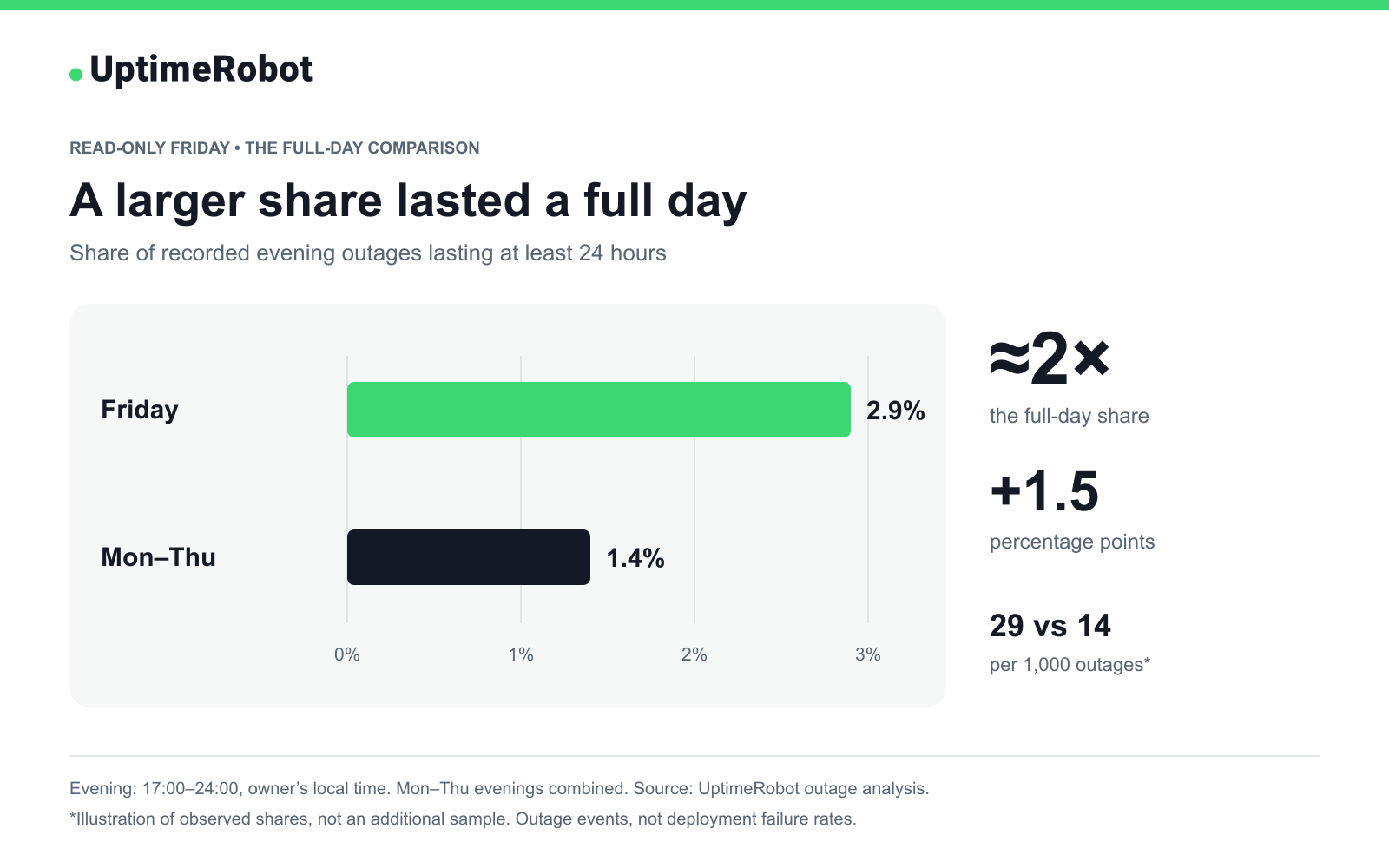
Yet 2.9% of Friday evening outages lasted at least 24 hours, compared with 1.4% on other weekday evenings.
We looked at what these patterns reveal about Friday downtime, how they relate to the read-only Friday debate, and what teams should consider before heading into the weekend.
What is read-only Friday?
Read-only Friday is the practice of avoiding nonessential production changes on Fridays, particularly before the weekend. Teams may postpone releases, infrastructure changes or database migrations to a period when more people are available to respond.
The reasoning is that a change causing trouble late in the week could leave a service impaired when recovery is harder to coordinate.
Outage records alone can’t establish whether that policy works. To measure deployment risk, you would also need to know when changes happened, how many were made, and which caused incidents.
Our data records outage timing through down and up notifications. It doesn’t record deployments.
The new finding: Friday evening outages have a longer tail
Our earlier downtime patterns report examined when outages occur. This analysis looks at how long evening outages last, with Friday standing out for incidents that continue into the following day.
| Measure | Friday evening | Monday–Thursday evenings |
| Outage starts per hour | About 27% fewer | Comparison baseline |
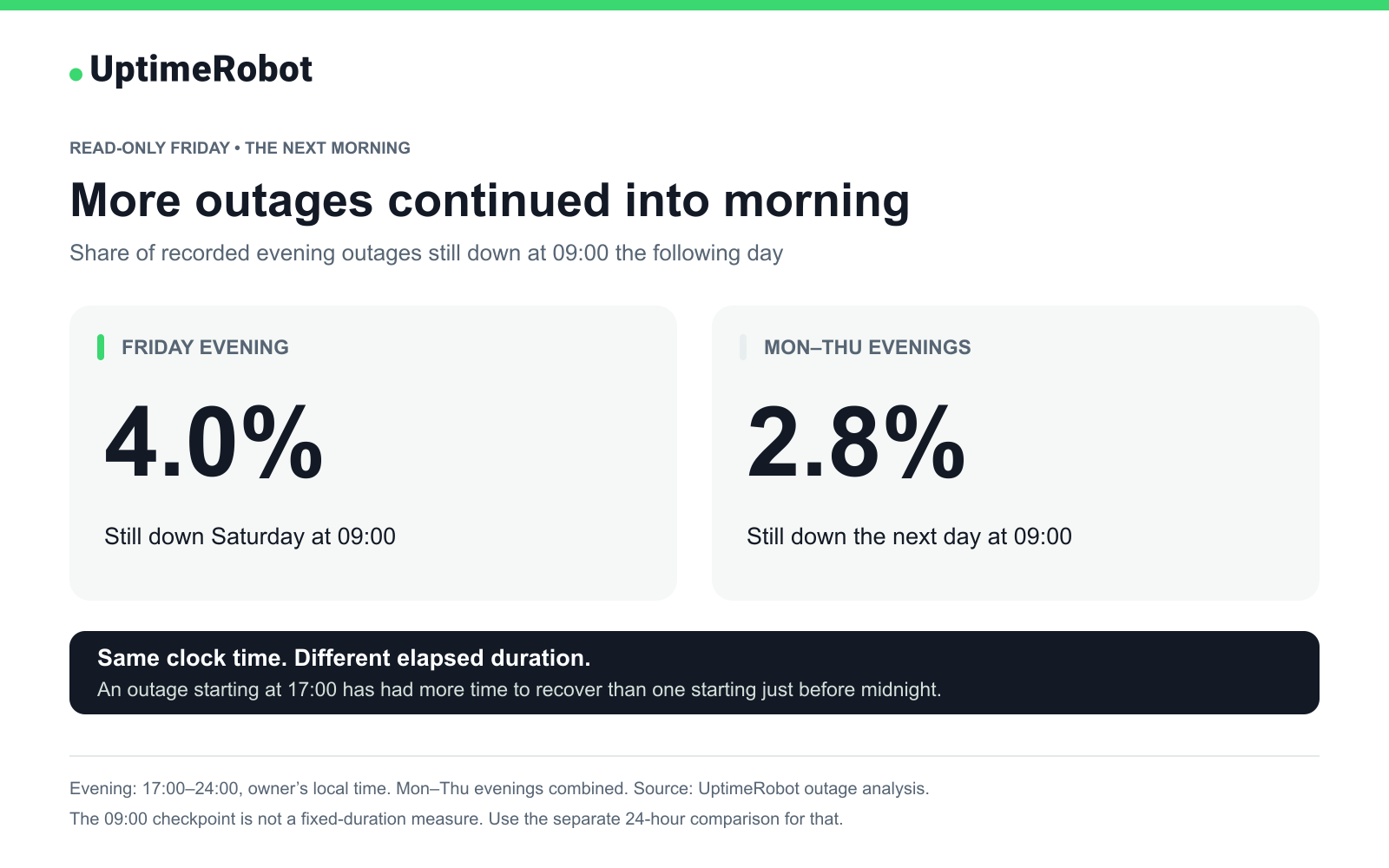
| Share still down at 09:00 the following morning | 4.0% | 2.8% |
| Share lasting at least 24 hours | 2.9% | 1.4% |
Evening means 17:00–24:00 in the account owner’s local time. Monday–Thursday evenings are combined for comparison.
The duration figures describe outages that had already started. They are monitor-weighted median weekly percentages: each monitor contributes equal total weight across the analysis period, and we report the median of the weekly percentages.
Weighting reduces the influence of frequently failing monitors, while reporting the median limits the influence of unusually high-outage weeks.
The difference is in the longest outages
The share of outages lasting at least 30 minutes was similar across Friday and other weekday evenings, at approximately 14-15%.
The difference becomes clearer among prolonged incidents.
Friday had the highest monitor-weighted share of outages lasting at least 24 hours across all seven evenings. It also ranked highest when we repeated the analysis separately for two groups of 3,500 account owners.
The difference between the reported estimates of 2.9% and 1.4% amounts to 1.5 percentage points.
Most outages are resolved well before the 24-hour mark. The finding is that a relatively small proportion of Friday evening incidents continue substantially longer.
What “still down the next morning” means
For a Friday evening outage, the next-morning checkpoint is Saturday at 09:00. For a Monday evening outage, it is Tuesday at 09:00, and so on.
The checkpoint uses the same clock-time rule for every evening. It isn’t a fixed outage duration: an incident beginning at 17:00 has had more time to recover than one beginning just before midnight.
In the sample, 4.0% of Friday evening outages were still down at that checkpoint, compared with 2.8% on other weekday evenings.
The separate 24-hour measure provides a fixed-duration comparison regardless of when within the evening an outage began.
Does this prove teams should avoid Friday deployments?
The data doesn’t establish whether Friday deployments cause more outages or whether a deployment freeze prevents them.
Friday evenings had fewer outage starts per hour, which could reflect teams making fewer changes before the weekend. But UptimeRobot’s records track outages, not deployments, so we can’t test that explanation.
The analysis also can’t tell us why Friday evening outages lasted longer. Staffing, escalation procedures, incident severity and external dependencies could all play a role.
What we do know is that a larger share of Friday evening outages remained unresolved the following morning or lasted at least 24 hours.
What teams can do with this finding
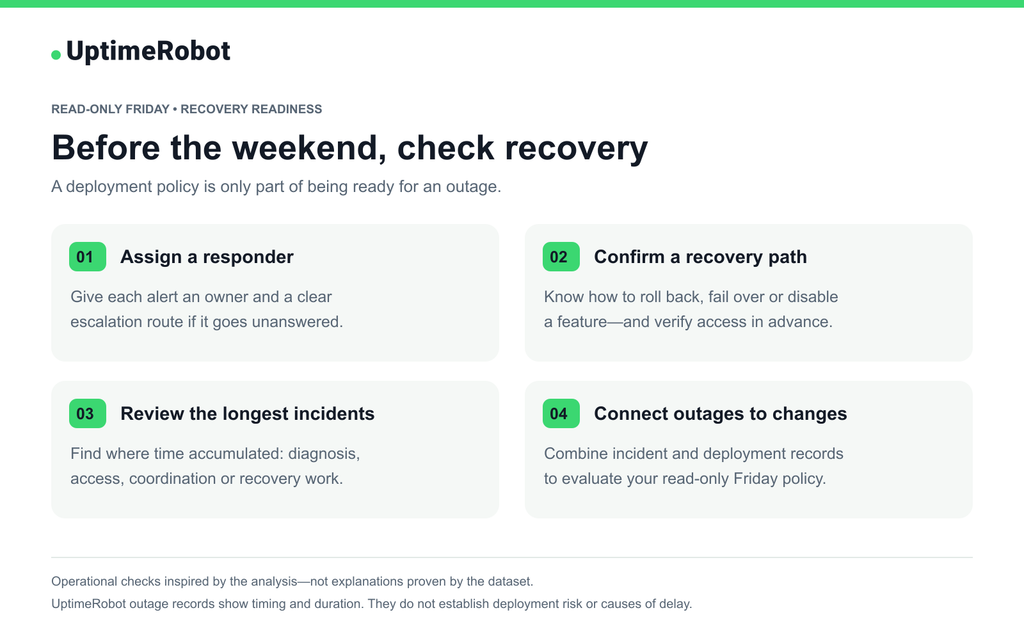
Friday’s higher share of prolonged outages makes weekend recovery readiness worth reviewing, especially for teams that already limit deployments before the weekend.
Confirm who owns an unresolved alert
Make sure an alert has a responsible responder and an escalation route if that person doesn’t acknowledge it.
An alert reaching an inbox is different from someone taking ownership of the incident.
Prepare a recovery path before making a change
For a planned release or configuration change, identify how service could be restored if something goes wrong.
That might involve a rollback, a failover or disabling a problematic feature. Confirm that the people responsible can access the systems and permissions they need.
Review incidents that continue past the initial response
A quick acknowledgement doesn’t guarantee a quick recovery.
Look at incidents that remained open into the following morning or lasted a full day. Identify where time accumulated: diagnosis, access, coordination, external dependencies or recovery work.
Measure your own Friday pattern
Compare similar services, incident severities and time windows. Keep check intervals and alert settings consistent where possible.
If you’re evaluating a read-only Friday policy, compare incident records with deployment and change records to see how outages relate to releases.
How we analyzed evening outages
The sample included 7,000 randomly selected account owners in single-timezone countries, covering 105,680 website monitors and approximately 4.4 million outages over 51 full weeks, from October 6, 2025 to September 27, 2026.
Times were assigned using each owner’s billing country and adjusted for daylight saving time.
The sample was mostly European, led by the UK, Germany, the Netherlands and France. 93% of account owners were current or former paying customers: approximately 61% current, 32% former and 7% free.
Our analysis was entirely based on this monitoring population, and should not be treated as representative of every website, country or engineering team.
How outage frequency was compared
The analysis compared outage starts per hour, so the seven-hour Friday evening window could be compared with the equivalent Monday–Thursday windows.
The typical-week calculation used the median of weekly patterns to reduce the influence of individual mass outage events. Monitors were weighted equally so that a small number of frequently failing monitors wouldn’t dominate the timing comparison.
What the records can miss
Recorded outage duration runs from a down notification to an up notification. Check intervals and confirmation settings affect which interruptions appear and how precisely their duration is measured.
Maintenance windows can suppress alerts, so some downtime is absent from the records. The available data also doesn’t establish whether incidents that users excluded from their reports are present in the notification records analyzed. The analysis excludes unrecovered outages.
A website can have multiple monitors. The results describe monitored outage events, not a count of unique businesses or deployment failures.
Make recovery part of the Friday decision
A read-only Friday policy addresses which changes a team chooses to make. It does not answer how the team will respond if a service fails anyway.
UptimeRobot’s data shows a quieter Friday evening can still contain incidents that persist well into the weekend. Review your escalation coverage, recovery procedures and longest incidents alongside your deployment policy.
Monitor your website with UptimeRobot to record availability and receive downtime alerts. Combine that record with your team’s incident timeline to understand where recovery takes time.
Frequently asked questions
What does read-only Friday mean?
It usually means avoiding nonessential production changes on Fridays, particularly before the weekend. The exact scope varies by team.
Are Friday evening outages more common?
Not in this sample. Outages started about 27% less often per hour on Friday evenings than on Monday–Thursday evenings.
Are Friday evening outages more likely to last a full day?
Yes, in this sample. 2.9% of Friday evening outages lasted at least 24 hours, compared with 1.4% on other weekday evenings. That is roughly twice the share, with an absolute difference of 1.5 percentage points.
Does the data show Friday deployments are riskier?
No. The dataset records outage timing, not deployment timing. Based on this data, you can’t calculate deployment failure rates or establish whether avoiding Friday changes reduces incidents.
Why do Friday evening outages last longer?
The analysis does not establish a cause. It shows a higher share of prolonged outages, but it does not measure staffing, deployment activity or the reasons for delayed recovery.