TL;DR (QUICK ANSWER)
A 5-minute check misses many short outages, and the ones it catches look like they lasted about 5 minutes. On websites checked every minute, most outages are over in less than 5 minutes, so a slower check only sees one if a check happens to land inside it. It still catches the long outages that cause most downtime. For checkout, sign-in, and APIs, check every 60 seconds or faster.
A monitor only sees your website at the moments it checks. Whatever happens between two checks goes unseen.
On websites checked every minute, most outages are over in less than 5 minutes. A monitor that checks every 5 minutes only sees one of those if a check happens to land inside it.
We looked at 12 months of outages on a random sample of over 113,000 monitored websites to see how much the check interval decides what a monitor can see. Here’s what we found.
Key takeaways
- On websites checked every minute, more than half of outages are over within 5 minutes, and a quarter within a minute or two. The typical one is over within 2 to 4 minutes.
- On monitors checked every 2 to 5 minutes, at least a quarter of recorded outages last about 5 minutes (one check cycle on a 5-minute monitor). A monitor can’t record an outage shorter than its check interval.
- Long outages still cause the majority of the downtime. On websites checked every minute or faster, fewer than 1 in 20 outages last longer than an hour, yet they cause 85 to 91% of recorded downtime.
- UptimeRobot checks every 5 minutes on Free, every 60 seconds on Solo, every 30 seconds on Team, and every 15 seconds on Scale.
Source: UptimeRobot. A random 5% of HTTP and keyword monitors, 12 months to September 30, 2026.
A monitor only sees the outages its checks land in
Every check is a snapshot. If the site is down when a check runs, the monitor sees it. If the site goes down and comes back between two checks, the monitor never knows.
For example, let’s imagine a 3-minute outage that starts 30 seconds after a check:
- Checked every 5 minutes: The checks before and after it both find the site up. The outage isn’t recorded.
- Checked every 60 seconds: Three checks land inside it. The monitor goes down, then comes back up at the first check after the site recovers.
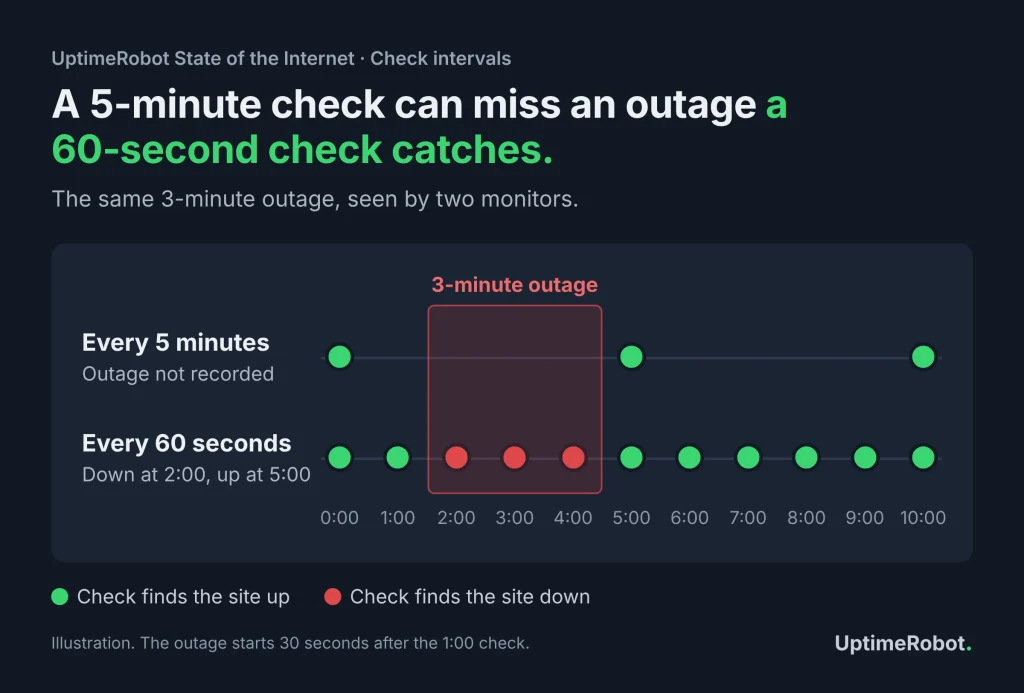
Whether a 5-minute check catches an outage like that comes down to timing. With checks 5 minutes apart, a 3-minute outage is caught about 3 times in 5, and a 1-minute outage about 1 time in 5. The failed check also has to be confirmed by a re-check before the monitor goes down, so the real odds are a little lower.
The interval also sets how long a caught outage looks. A monitor only sees the site come back at its next check, so every outage it records lasts about one check interval or longer. A 90-second outage that a 5-minute check happens to catch would be recorded as about 5 minutes.
On UptimeRobot, one failed check doesn’t mark a monitor down. The check is first repeated from a different data center in the same region, on every plan, so a blip that has cleared by then never becomes an alert.
On websites checked every minute, most outages are over in minutes
Monitors checked every minute miss the fewest outages, so they give the closest look at how long outages really last. They still miss outages under a minute, so if anything, short outages are more common than these numbers show. On those websites:
- A quarter of outages are over within a minute or two.
- The typical outage is over within 2 to 4 minutes.
- More than half are over within 5 minutes.
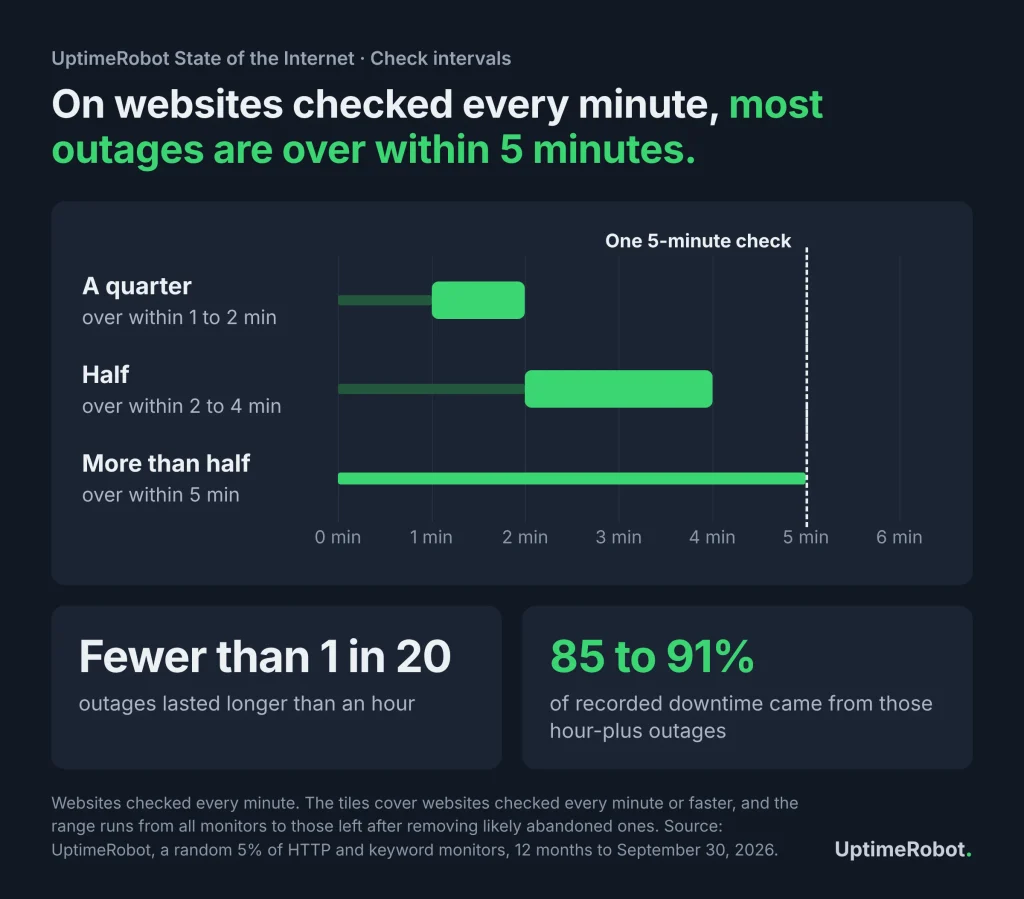
A monitor checked every 5 minutes either misses each of those shorter outages or records them as about 5 minutes long.
Short outages aren’t where most of the downtime is, though. On websites checked every minute or faster, fewer than 1 in 20 outages last longer than an hour, yet they cause 85 to 91% of recorded downtime. Even leaving out the rare outages that run longer than a day, hour-plus outages still cause 67 to 68% of the remaining downtime. A 5-minute check catches those just as well, but it can’t see the many short ones.
On monitors checked every 2 to 5 minutes, outages pile up at one check cycle
On monitors checked every 2 to 5 minutes, at least a quarter of recorded outages last about 5 minutes (one check cycle on a 5-minute monitor).
That doesn’t mean outages tend to last 5 minutes. This is simply the shortest outage these monitors can record. An outage that ends before the next check is either missed or recorded as one full check cycle, so short outages of every length land in the same place.
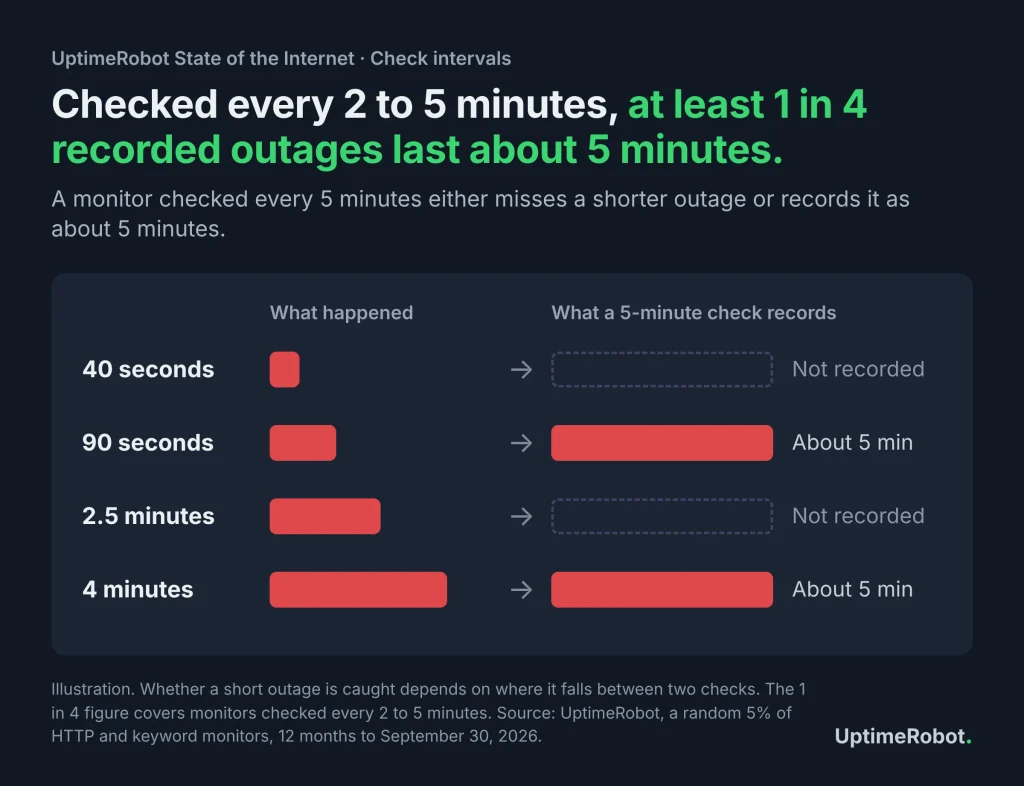
When a monitor checked every 5 minutes reports a 5-minute outage, don’t read it as a measured 5 minutes. All the monitor knows is that the site was down at one check and back up at the next. The real outage could have been much shorter or a little longer.
Why we don’t compare downtime between the two groups
It’s tempting to set the two groups side by side and conclude that faster checks mean less downtime. The data can’t show that.
Websites checked every minute are mostly on paid accounts. They’re a different set of websites, run by different teams with different setups, so any difference in their downtime could come from that rather than from the interval.
What the interval changes is what you can see. A faster check doesn’t make your site go down less often. It shows you the outages a slower check misses, and it measures the ones both catch more closely.
When a 5-minute check is enough, and when it isn’t
A 5-minute check is often enough for a blog, documentation, or a marketing site. Long outages cause the majority of downtime, and a 5-minute check catches those.
A faster check is worth it when:
- A minute of downtime costs you. Checkout, payments, sign-in, and public APIs other people build on all count. On those, a 3-minute outage is lost orders or failed requests, even if nobody reports it.
- You report an uptime figure. At 5 minutes, your number is coarse in both directions. Short outages are missed, and the ones you catch are rounded up to a full check. That matters when the allowance is small, since 99.9% uptime allows only 8 hours 45 minutes of downtime a year.
- The same short outage keeps coming back. A deploy that drops the site for a minute, or a server that restarts every few hours, mostly falls between 5-minute checks. You only see the pattern when checks are close enough together to catch it.
- You track how fast you recover. A monitor can’t measure a recovery faster than its own interval, so a 5-minute check can’t show whether your team fixed something in 2 minutes or 4. Your mean time to recovery (MTTR) is only as precise as your checks.
On August 16, 2013, Google went down for about 5 minutes, taking Gmail, YouTube, and Drive with it. Based on Google’s revenue that quarter, VentureBeat estimated the outage cost about $545,000, roughly $108,000 for every minute. An outage that short can start and end between two 5-minute checks. Short outages at shared providers spread fast, too. A Cloudflare change on December 5, 2025 lasted about 25 minutes, yet failures on the websites we monitor reached about six times a normal hour.
You don’t need one interval for everything. Put the services that cost you most on your plan’s fastest interval, and set the rest slower.
Check intervals on each UptimeRobot plan
Your plan sets the fastest interval a monitor can run, and you can set any monitor slower.
| Plan | Fastest check interval | Shortest outage it can record |
| Free | Every 5 minutes | About 5 minutes |
| Solo | Every 60 seconds | About 1 minute |
| Team | Every 30 seconds | About 30 seconds |
| Scale | Every 15 seconds | About 15 seconds |
On every plan, a failed check is repeated from a different data center in the same region before the monitor goes down.
See the outages your checks are missing
If your dashboard is full of 5-minute outages, that’s your check interval talking. Each one could have been much shorter than it looks, and the outages that fell between checks aren’t there at all.
Move the services where a minute of downtime costs you to faster checks. That’s checkout, sign-in, and your API, checked every 60 seconds on Solo, every 30 on Team, or every 15 on Scale. Leave your blog and docs on 5 minutes. UptimeRobot re-checks a failure from a different data center in the same region before it alerts you, on every plan, so a faster interval doesn’t mean more false alarms.
Start free with 50 monitors on 5-minute checks, no credit card needed, and move to faster checks when you’re ready.
How we measured this
- Monitors: A fixed random 5% of the HTTP and keyword monitors running on October 7, 2026. Not every monitor fits every question. Yearly uptime only uses monitors that existed all year, the year-on-year comparison only uses monitors that existed by May 2025, and dead monitors are dropped. So each figure rests on a slightly different count, between about 113,000 and 129,000 websites. Outage-length figures count outages, not websites, so the range doesn’t apply to them.
- Period: The 12 months to September 30, 2026.
- Outage: The time from a monitor going down to the same monitor coming back up. A monitor goes down only after the re-check from a different data center confirms the failure.
- Check interval: Each figure uses the interval the monitor actually ran at, not its plan’s fastest, and says which monitors it covers.
- Medians, not averages: A few outages that last weeks pull an average far above the typical outage.
- Excluded: Monitors with no successful check on the day of the pull, and three days of UptimeRobot’s own false alerts (August 1 and 16, 2025, and May 13, 2026). Websites that stopped being monitored before October aren’t in the sample, so the figures lean optimistic. Outages that never recorded a recovery are left out too, so the longest outages are, if anything, understated.
- Ranges: We give the typical outage on websites checked every minute as 2 to 4 minutes because the way outage lengths were recorded changed in July 2026.
-
It depends on what a minute of downtime costs you. Check sign-in, checkout, and APIs every minute or faster. For a blog or documentation, a 5-minute check catches the long outages that cause most of the downtime.
-
Yes. An outage that starts and ends between two checks isn’t recorded. On websites checked every minute, more than half of outages were over within 5 minutes.
-
Because about 5 minutes is the shortest outage a 5-minute check can record. On monitors checked every 2 to 5 minutes, at least a quarter of recorded outages last about 5 minutes (one check cycle on a 5-minute monitor).
-
Not by itself. It changes what you see, not how often your site goes down. What it can change is how soon you hear about an outage.
-
It shouldn’t. On every plan, a failed check is repeated from a different data center in the same region before the monitor goes down, whatever the interval.